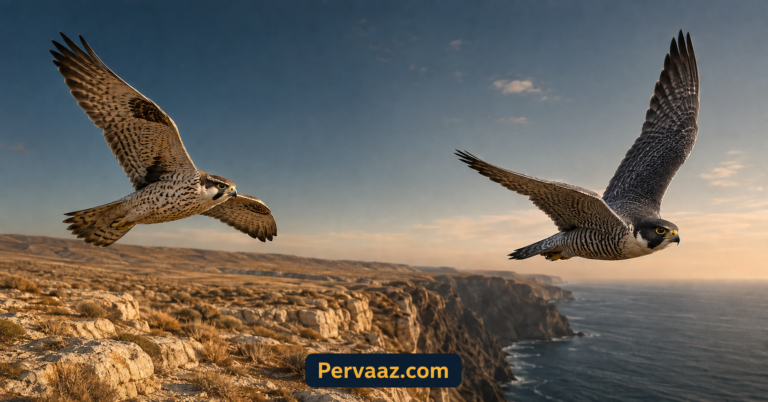

A falcon vs hawk in flight identification starts with shape, but one clue is rarely enough. Falcons usually look tapered, compact, and direct. Buteo hawks look broad-winged and buoyant. Accipiter hawks look long-tailed and agile. This guide compares the falcons, buteos, and accipiters most often seen over North America. It uses real flight photographs so you can judge wing shape, tail shape, soaring style, speed, and silhouette together.
Quick Answer: What Does the Bird’s Flight Suggest?
Watch the bird through several wingbeats and at least one glide. A single banking pose can make pointed wings look broad or broad wings look sharp.
| If you see this in flight | Most likely group | Best confirming clue |
| Tapered wings, compact center, direct powered flight | Falcon | Smooth pointed tips and a moderate tail |
| Broad inner wings, separated “fingers,” repeated circling | Buteo hawk | Wide tail and slow thermal soaring |
| Short rounded wings, long tail, burst-flap-glide rhythm | Accipiter hawk | Tail used as a large steering surface |
| Long wings and tail, low rocking flight with wings in a V | Northern Harrier or another exception | Low search flight over open ground |
These are tendencies, not rules. Falcons soar. Hawks fly fast. A correct identification should still make sense after the bird changes posture.
Why “Hawk” Is Not One Flight Shape
True falcons belong to Falconidae. The North American birds commonly called hawks belong to Accipitridae, a large family that also includes eagles, kites, harriers, and other raptors.
The word “hawk” creates an identification problem because it covers very different builds. A Red-tailed Hawk is a buteo. It has wide wings suited to soaring. A Cooper’s Hawk is an accipiter. It has shorter wings and a long tail suited to pursuit through woodland. Treating both as the same silhouette causes avoidable mistakes.
This guide therefore uses three working flight profiles: falcon, buteo hawk, and accipiter hawk. The distinction is more useful in the field than a simple two-column rule.
Wing Shape: The First Clue to Check
Judge the full wing during a glide when possible. Look at the inner wing near the body, the outer wing, and the tip. Do not judge only the position of the wrist.
Falcon Wings
A typical falcon wing narrows from a muscular base toward a pointed tip. A Peregrine Falcon can look like a compact anchor when seen head-on or from below. In level flight, its long outer flight feathers create a swept, tapered outline.
The tip is not always needle-sharp. A falcon may spread its feathers while slowing, turning, or soaring. Gyrfalcons are heavier and broader than peregrines. Kestrels can look relatively long-tailed. The useful pattern is the combination of a tapered outer wing, compact body, and controlled flight.
Buteo Hawk Wings
Buteos have broad inner wings. Their outer primaries often separate into obvious fingers during a soar. The entire wing carries more surface area than a typical falcon wing.
A Red-tailed Hawk often appears chesty and substantial. Its wide wings support slow circling in rising air. Swainson’s Hawks have longer and narrower wings than Red-tailed Hawks, so “broad and rounded” should not be treated as an absolute rule.
Accipiter Hawk Wings
Accipiters such as Cooper’s and Sharp-shinned Hawks have shorter, more rounded wings. This plan helps them accelerate and turn around trees. Their long tails provide much of the steering.
An accipiter can look cross-shaped in a glide. The head projects in front. The tail extends well behind. The wings appear compact compared with the bird’s length.
Direct Real-Photo Comparison: Peregrine Falcon vs Red-tailed Hawk
This pair shows the classic contrast. The Peregrine Falcon has a compact center and tapered outer wings. The Red-tailed Hawk has much broader wings. Its separated primaries create the fingered tip associated with soaring buteos.
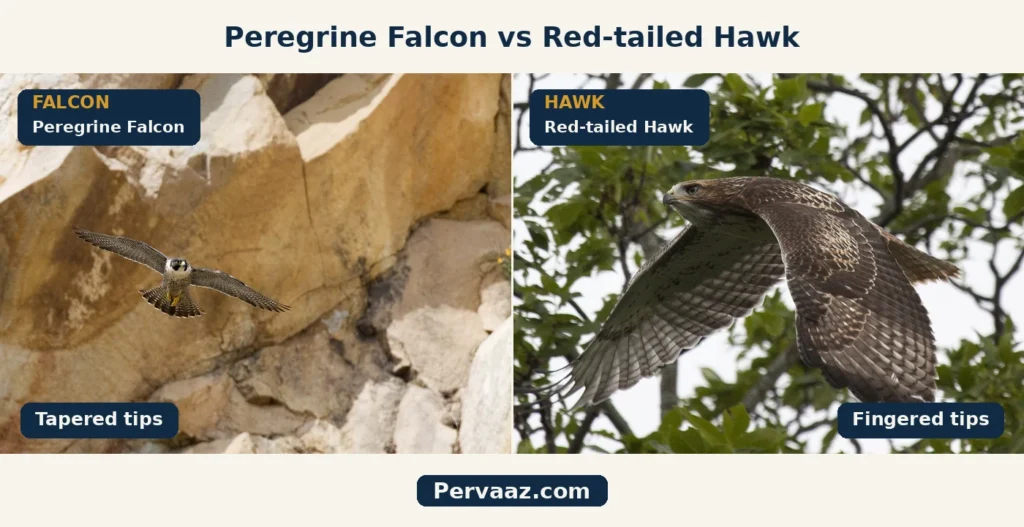
The camera angles are not identical, so do not compare apparent size. Compare how the outer wing meets the tip. The falcon narrows cleanly. The hawk carries a broad surface farther outward before the primaries separate.
Tail Shape: The Second Structural Clue
The tail changes as a bird turns, brakes, and glides. Watch it open and close rather than relying on one frame.
Falcons generally carry a moderate, fairly narrow tail during direct travel. They may fan it widely while braking or maneuvering. A fanned falcon tail does not cancel the tapered wing shape.
Buteos often show a broad tail base. A Red-tailed Hawk may spread its tail into a wide fan while circling. The tail is substantial, but it usually does not project far beyond the broad wings.
Accipiters have the most conspicuous tail-to-wing ratio. A Cooper’s Hawk carries a long, rounded tail. A Sharp-shinned Hawk often shows a squarer tail tip, though wear, molt, and viewing angle can blur the difference.
A short-winged bird with a long steering tail favors an accipiter. A broad-winged bird with a wide fan tail favors a buteo. A tapered-winged bird with a moderate tail favors a falcon.
Juvenile Falcons Can Look Broader-Winged
Young falcons deserve special caution. Their fresh juvenile flight feathers can make the wing look somewhat fuller and less sharply specialized than an adult’s. A fledgling may also fly with a less settled posture.
The broader impression does not make the juvenile an accipiter. Check the whole planform. The outer wing still tapers. The body remains compact. The tail does not dominate the silhouette in the way it does on a Cooper’s Hawk.
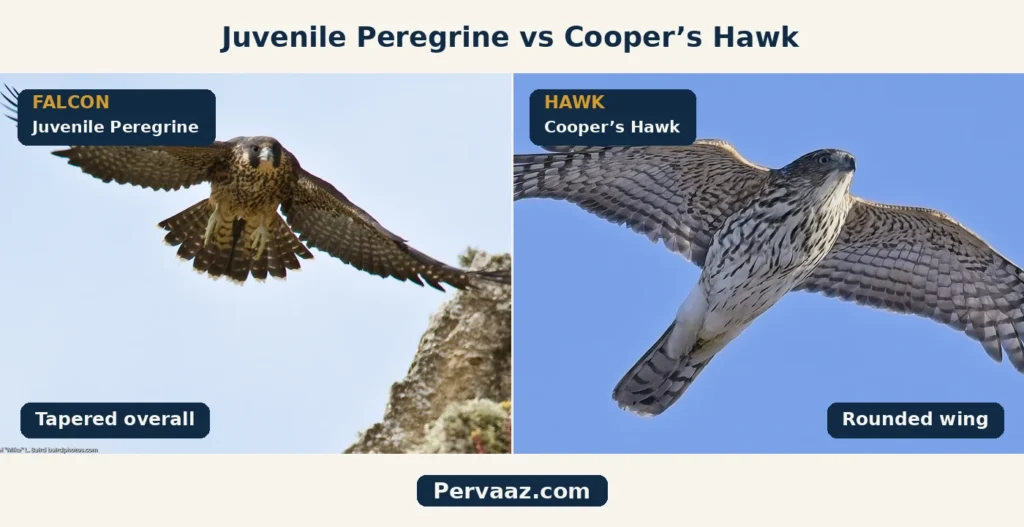
For more age-specific details, see the guide to juvenile Peregrine Falcon identification.
Soaring Style and Wing Position
Behavior often resolves an ambiguous silhouette. Watch how the bird uses moving air.
Buteo hawks commonly climb in thermals. They circle without flapping, gain height, then leave the thermal in a long glide. A Red-tailed Hawk may hold its wings nearly level or in a shallow V.
Falcons also use thermals, ridge lift, and urban updrafts. A soaring peregrine still tends to look compact. Its outer wings remain tapered. Its tail is less visually dominant than an accipiter’s.
Accipiters can soar during migration. At lower heights, they more often show a repeated burst of quick flaps followed by a short glide. That rhythm can be more reliable than color at a distance.
Northern Harriers are a major exception to the standard hawk shape. They have long wings and a long tail. They often fly low over fields with the wings held in a noticeable V. Their tilting, buoyant search flight differs from a falcon’s direct rush.
Flight Rhythm: Watch the Sequence, Not One Wingbeat
Falcon wingbeats often look quick, deep, and powerful. A traveling peregrine may use several fluid beats, pause in a brief glide, and continue along a direct line. A Merlin often looks more urgent and compact.
Accipiters commonly repeat a burst-and-glide pattern. Birders often describe it as “flap-flap-flap, glide,” but the exact count varies. The grouped rhythm matters more than the number.
Buteos flap less when lift is available. Their beats look deliberate and heavy. A circling bird may hold the wings open for minutes while making small adjustments with individual primaries and the tail.
Speed: Separate Travel, Pursuit, and the Stoop
Speed supports an identification, but it should not lead it. Distance, wind, and viewing angle can make a moderate flight look extremely fast.
Cornell Lab reports that Peregrine Falcons average about 25–34 mph in traveling flight. They can reach approximately 69 mph in direct pursuit. In a hunting stoop from height, a peregrine may approach 200 mph. These are three different flight modes, not one generic “falcon speed.”
Hawks are not slow. Cooper’s Hawks make explosive attacks and turn rapidly around obstacles. Buteos can descend quickly toward prey or an intruder. Their familiar soaring style looks slower because they can stay aloft with little visible effort.
Use exceptional speed only when you observe the complete behavior. A steep, wing-folded hunting stoop strongly favors a falcon. A bird that simply crosses the sky quickly is not identified by speed alone.
American Kestrel vs Sharp-shinned Hawk in Flight
These small raptors can overlap in apparent size. The kestrel has tapered wings and is more likely to hunt over open ground. The Sharp-shinned Hawk has rounded wings, a long banded tail, and a flight style associated with woodland edges and surprise pursuit.
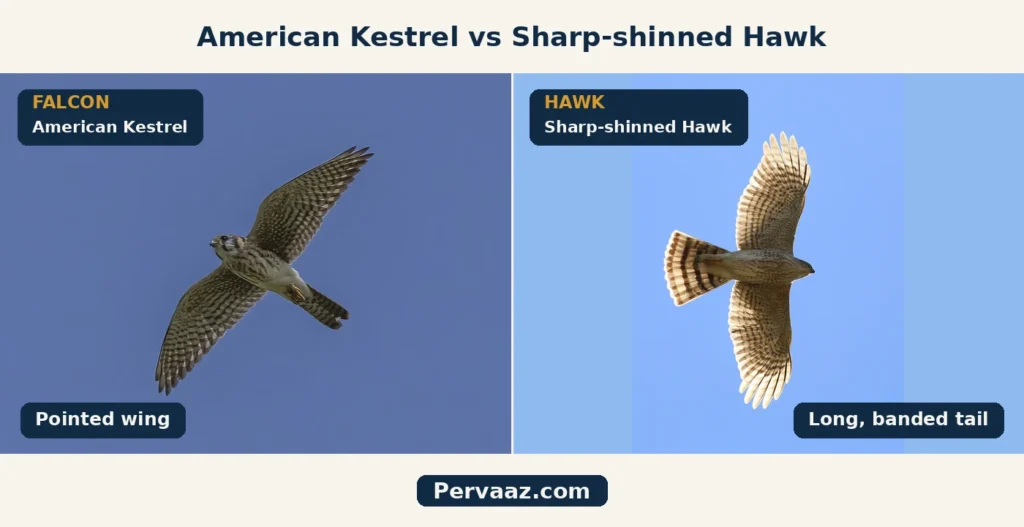
Hovering favors a kestrel, especially over open habitat. It does not prove the bird is a falcon. Red-tailed Hawks, Rough-legged Hawks, and kites can also hold position in strong wind.
Falcon, Buteo, and Accipiter Silhouettes
The three-shape model below summarizes the most useful structural and behavioral differences. The silhouettes are illustrated and not to scale. They are designed to show planform, not species plumage.
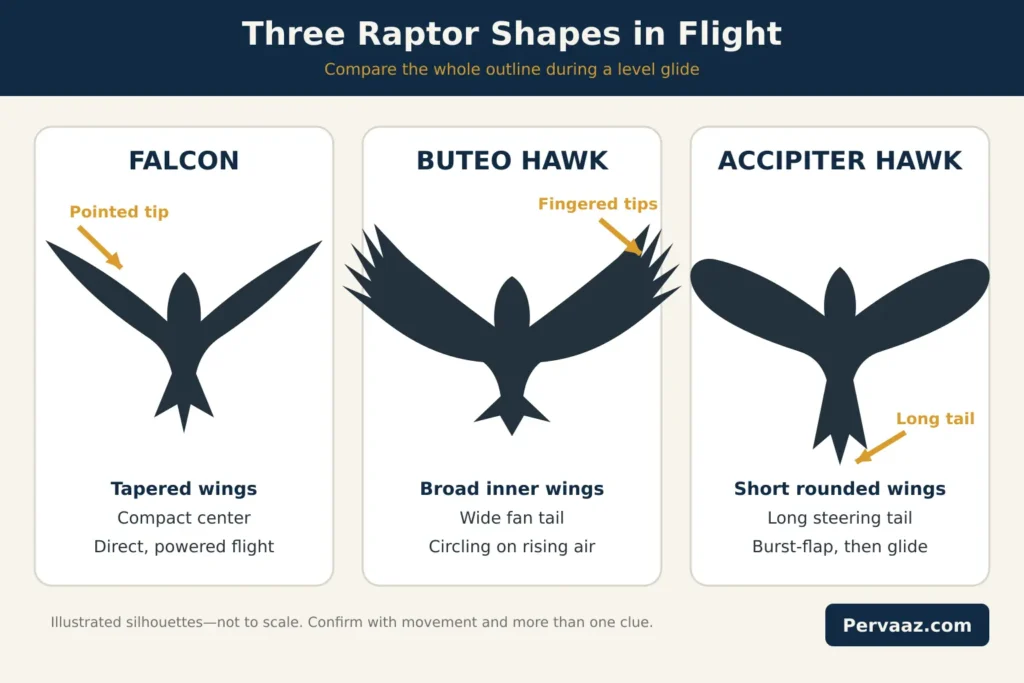
The cleanest comparison appears in a level glide. Falcons taper. Buteos carry broad inner wings and fingered tips. Accipiters combine rounded wings with a long steering tail.
A Five-Step Field Identification Method
Use the same sequence each time. It keeps one exciting clue from overpowering the rest.
- Watch for a glide. Decide whether the wings taper, remain broad, or look short and rounded.
- Compare tail length with wing width. A long tail favors an accipiter. A wide fan with broad wings favors a buteo.
- Follow one complete movement sequence. Note direct powered flight, thermal circling, or a burst-flap-glide rhythm.
- Check the center of the silhouette. Falcons look compact. Buteos look heavy. Accipiters often show a projecting head.
- Use plumage last. Confirm with underwing contrast, dark wrist marks, tail bands, facial pattern, or other species-level marks.
If two structural clues conflict, keep the identification broad. “Falcon,” “buteo,” or “accipiter” is a better record than a confident but unsupported species name.
When Wing Shape Misleads
A raptor does not hold one permanent silhouette. A banking falcon can spread its inner wing and hide the outer tip. A buteo in a fast glide can pull its wings back and appear pointed. An accipiter seen head-on can lose the apparent length of its tail.
Molt creates gaps and uneven edges. Strong backlighting erases feather detail. Wind changes both posture and speed. A still photograph can freeze the least typical moment in an otherwise diagnostic flight sequence.
This is why movement is evidence. Follow the bird long enough to see more than one posture.
Common Birds Mistaken for Falcons or Hawks
Pigeons have compact bodies, pointed-looking wings, and strong direct flight. In cities, they are frequent false falcons. Their smaller head, plumper chest, and fast continuous wingbeats usually expose them.
Crows can soar and show fingered wings. Their bill, head shape, and steady rowing wingbeats differ from those of most raptors.
Turkey Vultures hold their wings in a V and rock from side to side. Their small head and long, two-toned wings help separate them from buteos.
Ospreys have long, angled wings and can look gull-like. Their kinked wrist, pale underparts, and dark wrist patches distinguish them from typical falcons and hawks.
Conclusion
The most reliable falcon vs hawk in flight identification combines structure with movement. A typical falcon looks tapered-winged, compact, and direct. A buteo looks broad-winged, fingered, and buoyant. An accipiter looks rounded-winged, long-tailed, and built for burst-and-glide pursuit.
Do not force the identification from one frozen posture. Watch the wing plan, confirm with the tail, and test both against the flight rhythm. That method remains useful when color and fine detail disappear into the sky.
Frequently Asked Questions
These questions address the clues that most often cause confusion during real observations.
Can hawks have pointed wings?
Yes. Swainson’s Hawks have relatively long wings. Broad-winged Hawks can show a slight point. Any hawk may also pull its wings back during a fast glide. Check the inner-wing breadth, tail proportions, and flight behavior.
Do falcons soar in circles?
Yes. Falcons use thermals, ridge lift, and urban updrafts. A soaring peregrine still tends to show tapered outer wings, a compact body, and a moderate tail.
Which has the longer tail, a falcon or a hawk?
It depends on the hawk. Accipiters such as Cooper’s Hawks have very long tails. Buteos have broader, more moderate tails. Falcons usually have moderate tails, although kestrels can look fairly long-tailed.
Is a fast raptor always a falcon?
No. Accipiters accelerate rapidly, and buteos can dive at speed. Speed becomes useful when paired with a falcon’s tapered shape and a recognizable pursuit or stooping sequence.
What does “fingered wingtips” mean?
It describes separated outer primary feathers. On a soaring buteo, each primary forms a visible projection. Falcons usually present a smoother, more tapered outer wing.
What is the best clue at long distance?
Start with the wing plan during a glide. Then confirm it with tail proportion and flight rhythm. No single clue is infallible.
Editorial Reference Note
Flight descriptions and Peregrine Falcon speed figures were checked against the Cornell Lab of Ornithology’s Peregrine Falcon identification guide and species overview. The multi-clue method is consistent with Audubon’s field guidance for identifying raptors.
- Peregrine Falcon photograph: Mike Baird, CC BY 2.0. Source: https://commons.wikimedia.org/wiki/File:1_of_2_Peregrine_Falcon_(Falco_peregrinus)_Morro_Rock.jpg
- Red-tailed Hawk photograph: Warren Garst/Colorado State University Libraries, CC BY-SA 4.0. Source: https://commons.wikimedia.org/wiki/File:Red-tailed_hawk_in_flight_-_DPLA_-_3ee99e618b6404cdc745fa3cf2b6266b.jpg
- Peregrine Falcon photograph: Kevin Cole, CC BY 2.0. Source: https://commons.wikimedia.org/wiki/File:Peregrine_Falcon_in_flight.jpg
- Red-tailed Hawk photograph: John Kees, CC BY-SA 3.0. Source: https://commons.wikimedia.org/wiki/File:Red_Tailed_Hawk_in_flight.jpg
- Juvenile Peregrine Falcon photograph: Mike Baird, CC BY 2.0. Source: https://commons.wikimedia.org/wiki/File:8_of_9_Peregrine_Falcon_Juvenile_Fledgling,_Morro_Bay,_CA_27_May_2008_(2530316148).jpg
- Cooper’s Hawk photograph: Mykola Swarnyk, CC BY-SA 4.0. Source: https://commons.wikimedia.org/wiki/File:Cooper%27s_Hawk_Accipiter_cooperii_in_flight_Downsview_Park_Toronto.jpg
- American Kestrel photograph: Charles J. Sharp, CC BY-SA 4.0. Source: https://commons.wikimedia.org/wiki/File:American_kestrel_(Falco_sparverius_tropicalis)_female_in_flight_Cayo.jpg
- Sharp-shinned Hawk photograph: Seabamirum, CC BY 2.0. Source: https://commons.wikimedia.org/wiki/File:Sharp-shinned_Hawk_flying.jpg