

A prairie falcon and a peregrine falcon can look almost identical when they flash past at speed. Both are powerful, crow-sized falcons with pointed wings. The fastest way to separate them is to look underneath the wing. Prairie falcons have concentrated dark patches where the wings meet the body. Peregrines look more evenly barred below and usually show a darker hood, a broader mustache, and a heavier build.
The prairie falcon’s concentrated dark axillary patch is the strongest flight mark. The peregrine’s underside is more evenly barred. Photo credits and licenses are listed after the article.
Prairie Falcon vs Peregrine Falcon: The Short Answer
The two species overlap in length and wingspan, so size alone rarely settles the identification. Color, underwing pattern, facial markings, habitat, and hunting behavior are more useful.
Prairie falcons are usually sandy brown above and pale below. They have a relatively narrow mustache mark and distinctive dark axillary patches. They are closely associated with deserts, grasslands, sagebrush, and other dry open landscapes in western North America.
Peregrine falcons are generally darker and more strongly patterned. Adults have blue-gray upperparts, a bold dark hood, a broad mustache, and barred underparts. They occur across most of the world and readily use cliffs, coasts, wetlands, bridges, and tall city buildings.
If you have only a few seconds, use this order: check the underwing, check the face, and then consider the habitat.
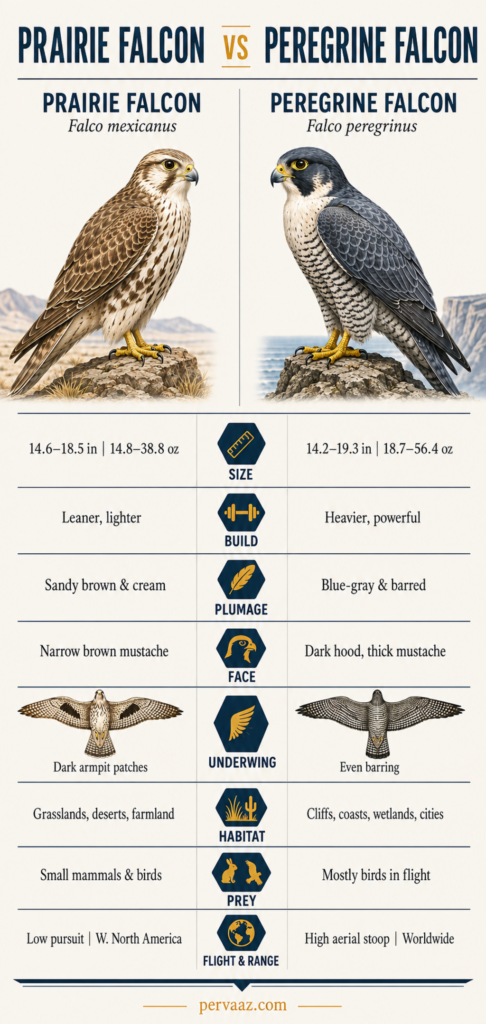
Size and Build Differences
Prairie and peregrine falcons overlap so much in body length that an observer should not identify either species by apparent size alone. Distance, posture, wind, and sex can all change how large a falcon looks.
A prairie falcon measures about 14.6–18.5 inches long and weighs roughly 14.8–38.8 ounces. Its wingspan is about 35.4–44.5 inches.
A peregrine falcon measures about 14.2–19.3 inches long and weighs roughly 18.7–56.4 ounces. Its wingspan is about 39.4–43.3 inches.
The important difference is mass rather than length. A peregrine can be considerably heavier. It often looks deeper-chested, broader through the shoulders, and more compact. A prairie falcon usually gives a leaner, slightly longer-bodied impression.
Female falcons are larger than males. A large female prairie falcon can therefore appear bigger than a male peregrine. A female peregrine, however, is normally the heavier and more powerfully built bird.
Plumage and Facial Markings
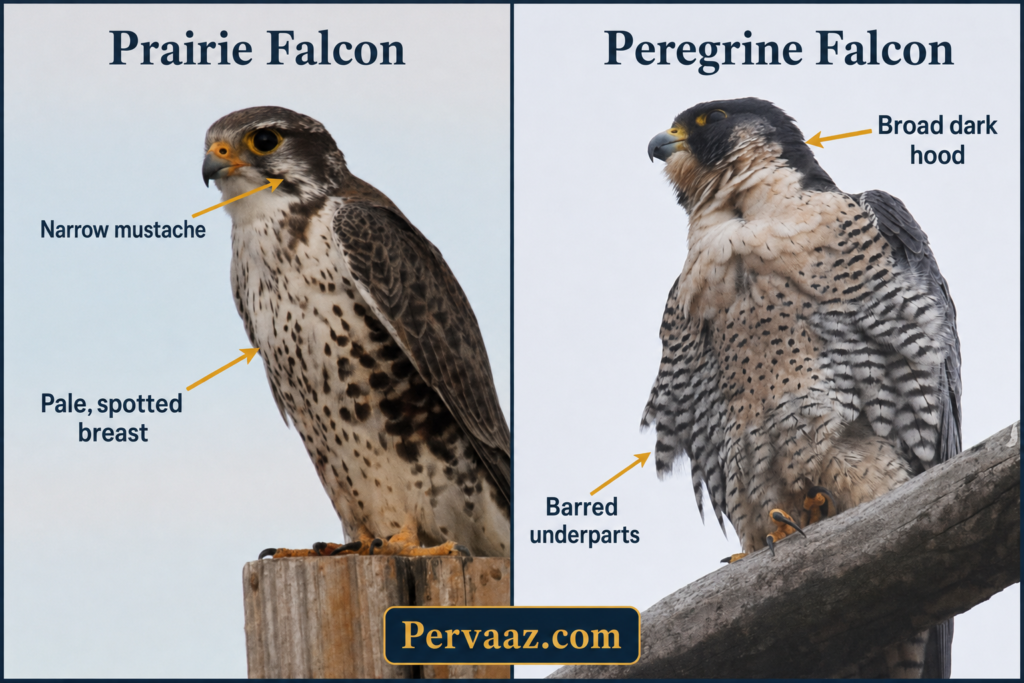
Plumage is most useful when the falcon is perched or flying close enough for the head and body pattern to be seen. Do not rely on a single shade of brown or gray. Light can make either bird look paler or darker than expected.
Prairie falcons tend to look paler and more open-faced. Adult peregrines show a broader dark hood and more extensive barring below. Photo credits and licenses are listed after the article.
Prairie Falcon Plumage
An adult prairie falcon is warm brown or sandy brown above. The head, throat, and underparts are pale cream. Brown spots, short streaks, or teardrop-shaped marks cover parts of the breast and belly, but the underside often looks lighter and less uniformly patterned than that of a peregrine.
The face is relatively pale. A narrow brown mustache runs below the eye. A pale eyebrow may also be visible, giving the bird a more open-faced appearance.
The crown is brown rather than slate-gray or blackish. The upper tail may look paler than the back and folded wings, especially when the bird turns away in bright light.
Peregrine Falcon Plumage
An adult peregrine is blue-gray to slate-gray above. Its crown and sides of the head are dark. A broad mustache extends down the cheek and visually connects with the crown, creating the familiar hooded appearance.
The pale throat and cheek contrast strongly with this dark helmet. The lower breast, belly, and flanks usually carry fine horizontal barring. The pattern is more even and extensive than the scattered spots seen on many adult prairie falcons.
Peregrine plumage varies among geographic populations. Some birds are paler than the classic field-guide image. Even then, the mustache is normally broader, the head looks more heavily hooded, and the underside is more consistently patterned.
The Most Reliable Underwing Difference
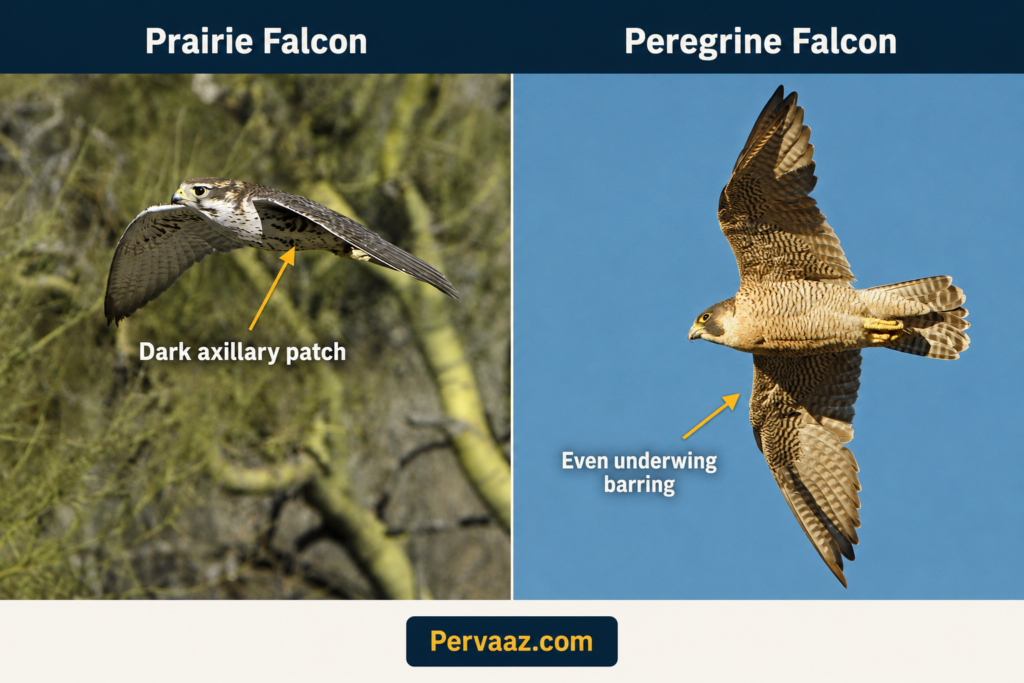
The best flight mark is located at the base of the wing.
Prairie falcons have dark axillary feathers. These form a concentrated patch where each wing joins the body. Birders often call these marks the bird’s “dark armpits.” The patches contrast with the paler body and inner wings.
A peregrine may have dark and heavily patterned underwings, but the pattern is spread more evenly across the flight feathers and body. It does not normally form the same isolated pair of dark axillary blocks.
This distinction is strongest when the bird banks or passes overhead. If the light is poor, avoid forcing an identification. A shadowed peregrine wing can appear to have a dark patch, while glare can hide the prairie falcon’s mark.
Prairie Falcon vs Peregrine Falcon in Flight
Both species have long, pointed wings and can accelerate rapidly. Their silhouettes overlap. The way they use the landscape often provides a better clue than wing shape alone.
Prairie Falcon Flight Style
Prairie falcons often hunt low over open country. A bird may race across sagebrush, desert flats, or grassland while following the shape of the ground. It can disappear behind a ridge and reappear at high speed, using terrain to conceal its approach.
This low pursuit suits prey such as ground squirrels and open-country birds. The flight can look urgent and direct, with strong wingbeats followed by short glides.
Prairie falcons also soar and perform steep dives. A diving falcon is not automatically a peregrine. The combination of low hunting, dry open habitat, pale plumage, and dark axillary patches is much more informative.
Peregrine Falcon Flight Style
Peregrines frequently hunt from height. They may circle above a flock or watch from a cliff, bridge, tower, or tall building. Once a bird is selected, the peregrine can attack from above or behind.
Its famous high-speed dive is called a stoop. The wings draw back and the body becomes streamlined. The peregrine may strike or seize prey in the air before climbing or carrying it to a perch.
Ordinary peregrine flight is direct and powerful. The wingbeats can appear relatively shallow and controlled. A bird may alternate rapid flapping with short glides while traveling between hunting areas.
Which Falcon Is Faster?
The peregrine falcon is faster during a steep hunting stoop. Documented experimental dives have approached 240 mph. That figure describes an exceptional, controlled descent. It is not the peregrine’s normal level-flight speed.
Prairie falcons are also extremely fast. Their strength is rapid acceleration and low-altitude pursuit over uneven ground. A simple maximum-speed comparison misses the different ways these falcons hunt.
Range and Habitat Differences
Range can eliminate prairie falcon across much of the world. It is less decisive in western North America, where the two species overlap widely.
Where Prairie Falcons Live
The prairie falcon is a North American species. Its core distribution covers western Canada, much of the western United States, and parts of northern Mexico.
It favors dry, open landscapes. Typical habitat includes shortgrass prairie, sagebrush steppe, shrub desert, open agricultural country, canyonlands, and alpine tundra. Nesting birds need a cliff, bluff, rocky outcrop, or similar ledge near productive hunting ground.
Extensive forest is generally unsuitable. Trees are not essential to the species’ hunting strategy. Open sightlines and accessible prey matter more.
Where Peregrine Falcons Live
The peregrine falcon occurs on every continent except Antarctica. Populations occupy Arctic tundra, tropical coasts, deserts, mountains, islands, wetlands, and cities.
Natural nest sites include sea cliffs, river gorges, and mountain faces. Human structures can serve the same purpose. Skyscrapers, bridges, smokestacks, and towers provide high ledges and open airspace for hunting.
Prey abundance often matters more than vegetation. Coasts and wetlands attract peregrines because they concentrate shorebirds, waterfowl, gulls, and seabirds. Cities offer pigeons, starlings, and other abundant birds.
A pale falcon racing over sagebrush is more likely to be a prairie falcon. A large falcon hunting around a downtown tower or coastal cliff is more likely to be a peregrine. Habitat supports an identification, but it does not prove it.
Hunting and Diet Differences
The diets overlap, but each species has a clear emphasis. Prairie falcons take more terrestrial prey. Peregrines are more specialized for capturing birds in flight.
What Prairie Falcons Eat
Ground squirrels can form a major part of a prairie falcon’s breeding-season diet. The falcons also catch mice, pikas, small rabbits, lizards, large insects, and birds.
Bird prey becomes especially important outside the breeding season. Horned larks, meadowlarks, doves, and other open-country species may be chased close to the ground or taken after a short aerial pursuit.
A productive ground-squirrel colony can support a nesting pair for years. This link between prey and landscape helps explain the prairie falcon’s strong association with western grasslands and deserts.
What Peregrine Falcons Eat
Peregrines eat predominantly birds. Pigeons, shorebirds, ducks, gulls, songbirds, and seabirds are common prey. The falcon usually attacks while the target is airborne.
It may dive from above, close from behind, or force the prey into a difficult turn. Peregrines also catch bats and occasionally take prey from the ground, but aerial hunting is their defining specialty.
Juvenile Prairie Falcon vs Juvenile Peregrine Falcon
Young birds are harder to separate because both species can be brown above and vertically streaked below. Juvenile peregrines have not yet developed the blue-gray back and horizontal barring of an adult.
A juvenile peregrine usually looks dark-headed and robust. Its mustache is broad, and its underparts are often heavily streaked from the breast downward.
A juvenile prairie falcon tends to look sandier and more lightly headed. Its facial stripe is narrower, and a pale eyebrow may still be visible. The dark axillary patches remain the best flight mark.
Do not identify a juvenile from breast streaking alone. Use at least three features: the width of the mustache, the underwing pattern, and the bird’s overall color and build. Habitat and behavior can then strengthen the result.
A Practical Identification Method
Use one primary feature and two supporting features. This is more reliable than assembling a long checklist while the bird is moving.
First, check the base of the underwing. Concentrated dark axillary patches strongly favor prairie falcon. More evenly distributed barring favors peregrine.
Second, check the face. A pale face with a narrow brown mustache supports prairie falcon. A broad mustache connected to a dark hood supports peregrine.
Third, consider the setting and movement. Low pursuit over dry western country fits prairie falcon. High aerial attacks near cliffs, wetlands, coasts, or tall structures fit peregrine.
When all three clues agree, the identification is usually secure. When only habitat or apparent speed agrees, keep the bird unidentified until a physical field mark becomes visible.
Common Identification Mistakes
Several shortcuts cause avoidable errors.
Assuming Every Diving Falcon Is a Peregrine
Prairie falcons can make fast, steep dives. The peregrine is the more famous stooper, but the behavior is not exclusive to it. Check the underwings and face.
Using Size Alone
Length and wingspan overlap. Females are also substantially larger than males. Distance and posture can make the smaller bird appear larger.
Calling Every Pale Falcon a Prairie Falcon
Sunlight can wash out a peregrine’s color. Some peregrine populations are naturally pale. The dark axillary patches are more reliable than general brightness.
Ignoring Age
Juvenile peregrines are brown and vertically streaked. Juvenile prairie falcons are also more heavily streaked than adults. Adult-only plumage rules can therefore mislead.
Treating Habitat as Proof
Peregrines cross deserts, and prairie falcons sometimes visit cities. Migration and dispersal regularly place birds outside their most characteristic settings.
Conclusion
The prairie falcon vs peregrine falcon comparison becomes much easier when the clues are used in the right order. Start with the underwing. Dark axillary patches point to prairie falcon. Even barring points to peregrine.
Then check the face and overall build. Prairie falcons are usually paler, sandier, and more lightly built, with a narrow mustache. Peregrines are generally darker and heavier, with a broad hood and barred underparts.
Finally, use behavior and habitat as supporting evidence. A low-flying falcon over dry western grassland fits prairie falcon. A high aerial hunter near cliffs, wetlands, coasts, or city towers fits peregrine.
FAQs
Is a prairie falcon bigger than a peregrine falcon?
Not generally. Their length and wingspan overlap, but peregrines can become considerably heavier. A large female prairie falcon may still look bigger than a male peregrine.
What is the easiest way to tell them apart?
Look underneath the wings. A prairie falcon has concentrated dark axillary patches. A peregrine has a more evenly barred underside without the same isolated dark blocks.
Which falcon has the darker head?
The peregrine usually has the darker head. Its broad mustache and dark crown create a helmeted appearance. The prairie falcon has a paler face and a narrower brown mustache.
Can prairie falcons perform a stoop?
Yes. Prairie falcons can make steep hunting and territorial dives. A stoop alone does not identify a peregrine.
Which falcon is more common in cities?
The peregrine is much more strongly associated with cities. Tall buildings imitate cliffs, while pigeons and starlings provide abundant prey.
Do prairie and peregrine falcons live in the same areas?
Yes. They overlap widely in western North America. Prairie falcons favor dry inland landscapes, while peregrines use a broader range of cliffs, wetlands, coasts, mountains, and urban areas.
Can juvenile prairie and peregrine falcons be confused?
Yes. Both can be brown above and vertically streaked below. The prairie falcon’s dark axillary patches, paler facial pattern, and narrower mustache provide the best separation.
Do prairie falcons eat birds?
Yes. They catch many birds, especially outside the breeding season. They also take more ground squirrels and other small mammals than peregrines typically do.