

Juvenile peregrine falcon identification starts with pattern, not color alone. A young peregrine is usually brown above and strongly streaked below. Its broad cheek mark, pointed wings, powerful chest, and direct flight help separate it from other brown raptors.
Age makes the process more complicated. A five-week-old nestling, a newly flying fledgling, and a ten-month-old peregrine can all look different. Subspecies, feather wear, sex, and light add more variation. This guide explains what changes, what stays reliable, and when an exact age cannot be judged from appearance alone.
What Does a Juvenile Peregrine Falcon Look Like?
A fully feathered juvenile peregrine has dark-brown upperparts. Fresh feathers often have narrow buff or rusty edges. These pale margins can create a scaled look across the back and wing coverts.
The underparts are cream, buff, or warm tawny. Heavy dark-brown streaks run vertically from the upper breast toward the belly and flanks. This direction matters. Adults show fine spots on the upper breast and horizontal barring across much of the lower body.
The face combines a dark crown, a broad dark malar mark, and a paler cheek. The malar is the dark patch descending below the eye. Birders often call it a moustache or sideburn. A pale eyebrow can make a juvenile’s face look more patterned than an adult’s helmeted face.
Young birds usually begin with bluish-gray skin around the base of the bill and eye. The cere is the fleshy area around the nostrils. The feet and legs can also look pale blue-gray or dull. These soft parts become more yellow as the bird matures. The change is gradual, so soft-part color should support an identification rather than decide it by itself.
The Seven Most Useful Juvenile Peregrine Features
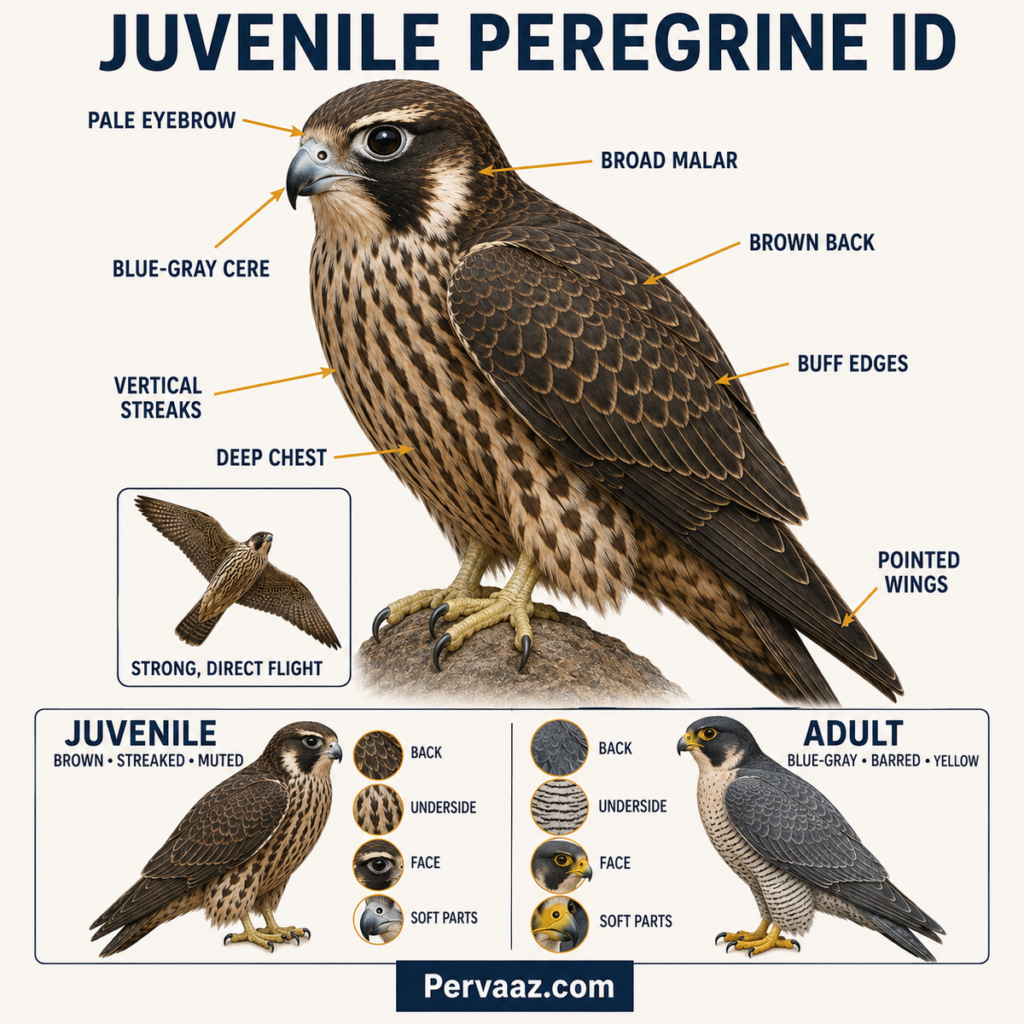
No single mark is reliable in every view. Use several features together. Start with the bird’s structure. Then check its face and underpart pattern.
| Feature | Typical juvenile appearance | Why it matters |
|---|---|---|
| Upperparts | Dark brown with narrow buff feather edges | Separates a young bird from the blue-gray adult |
| Underparts | Buffy with long, vertical brown streaks | One of the strongest age clues |
| Face | Broad dark malar mark with pale cheek or eyebrow | Helps distinguish it from Prairie Falcon and many hawks |
| Cere and eye-ring | Often blue-gray, becoming yellower with age | Useful supporting evidence on close birds |
| Wings | Long and pointed, even when the bird is young | Confirms falcon structure |
| Body | Deep-chested and powerful, with a relatively compact rear body | Helps separate Peregrine from slimmer falcons |
| Flight | Strong, shallow wingbeats and fast, direct travel | More useful than plumage at long range |
A fresh juvenile can look surprisingly neat and richly colored. A bird late in its first winter may look paler and less crisp. Sun, salt, wind, and abrasion wear away the buff feather edges. This does not turn the bird into an adult. The underparts remain longitudinally streaked until the first major molt replaces juvenile body feathers.
Juvenile Peregrine Falcon Identification by Age
Peregrines develop quickly. They go from white, downy chicks to flying falcons in roughly five to six weeks. Development does not proceed at exactly the same rate in every brood. Females are larger and can appear less advanced than a male of the same age because their feathers have farther to grow.
Hatch to 7 Days: White Down and Limited Movement
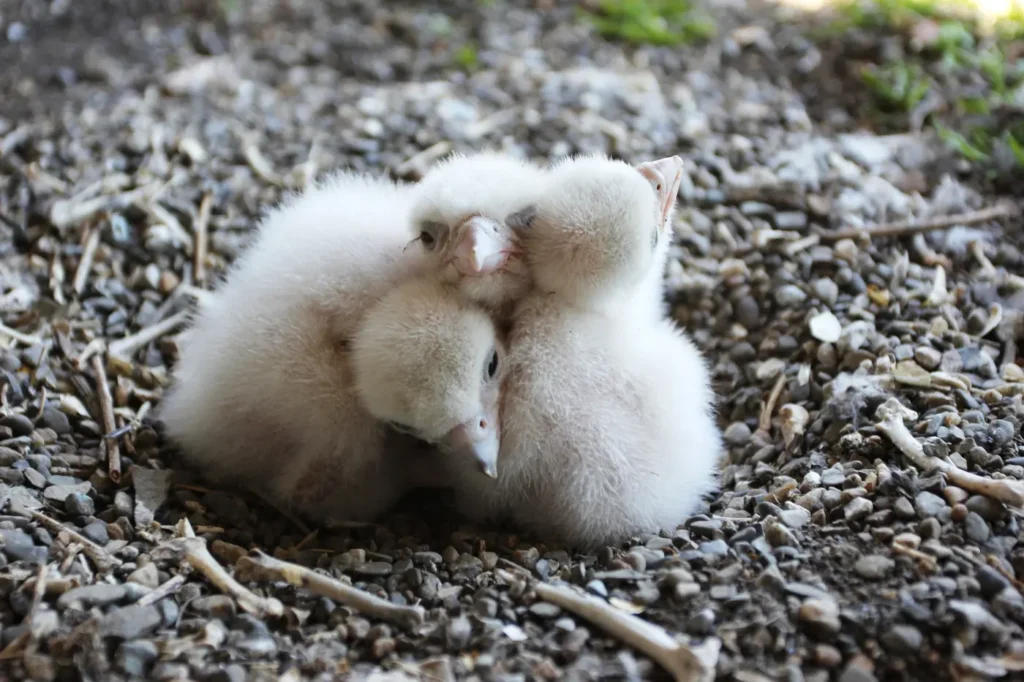
Newly hatched peregrines are covered in soft white or creamy down. The eyes are closed at first. The head looks large, while the wings are tiny. The feet already appear disproportionately big.
During the first week, the chick cannot stand or move with coordination. It sits low and often huddles against siblings. A second, thicker coat of down starts to develop. There is no visible juvenile plumage yet.
At this age, identification normally depends on the known nest and the attending adults. A white raptor chick photographed alone cannot be identified safely from down color.
8 to 14 Days: Pin Feathers Begin to Show
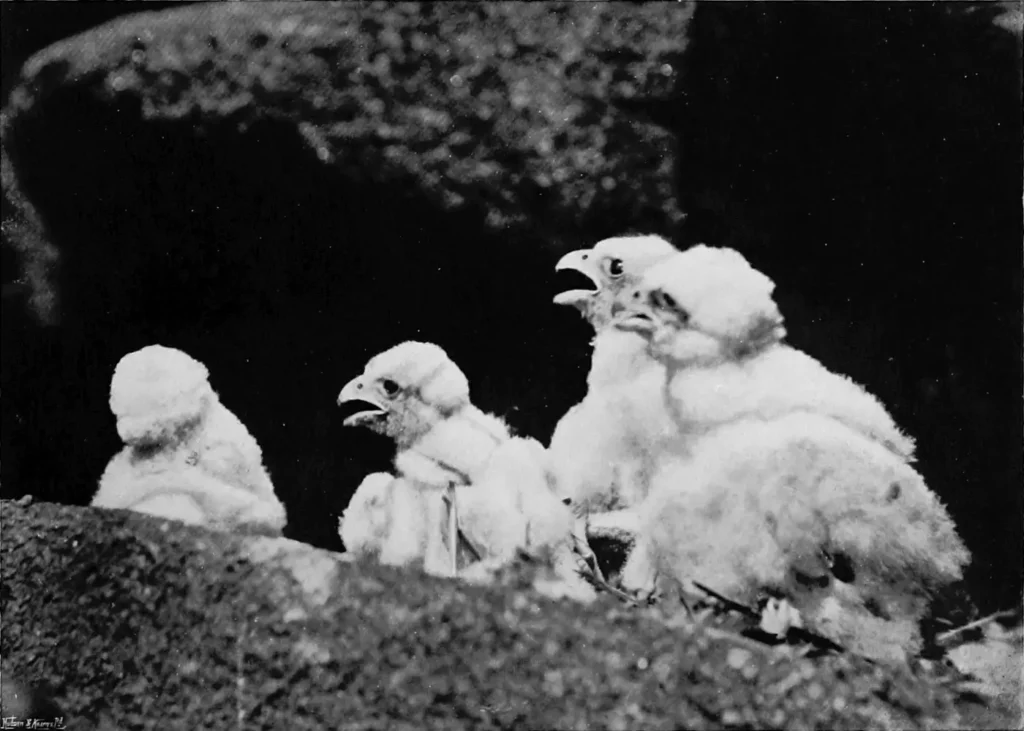
By the second week, the chick sits more upright. Dark pin feathers begin emerging along the wings. The beak and facial structure become more defined, but the bird remains overwhelmingly white.
The first wing feathers can look like dark quills projecting through the down. They are not damaged feathers. Each new feather is still enclosed in a protective sheath. The tail remains very short.
A dark eye, hooked bill, heavy feet, and known ledge nest support the identification. Plumage pattern is still too incomplete for a normal field comparison.
15 to 21 Days: The Face and Wings Take Shape
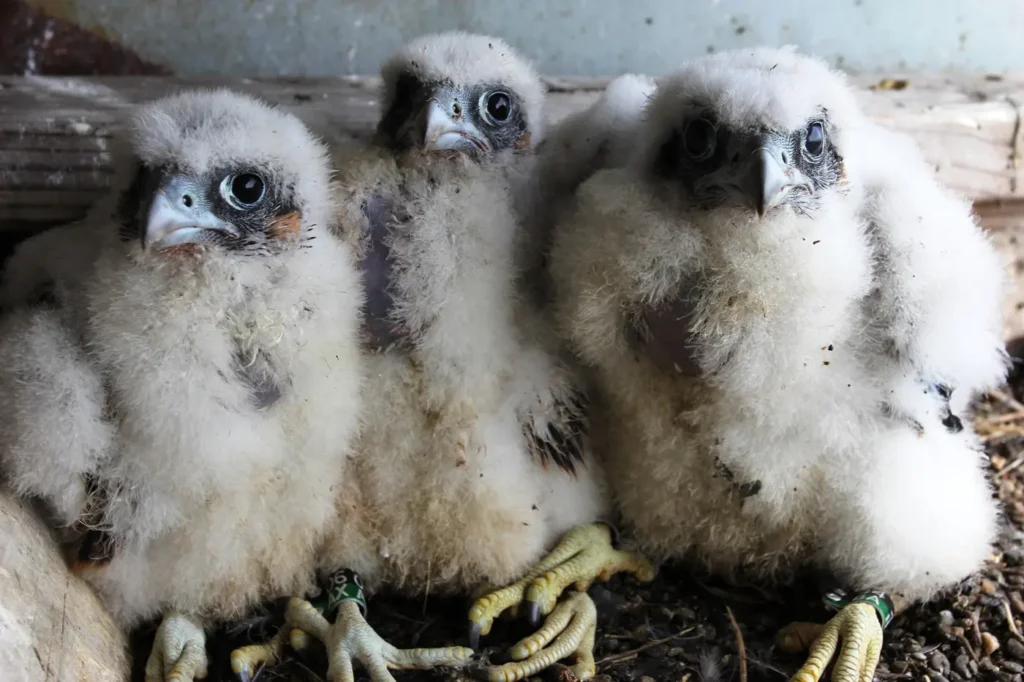
During the third week, dark feathering becomes obvious on the wings, back, and tail. The face starts to acquire the brown-and-buff juvenile pattern. White down still covers much of the body.
The growing flight feathers create an uneven, spiky outline. The young falcon can stand and walk more confidently. It also becomes more alert to activity around the nest.
At about three weeks, a peregrine chick should not look like a miniature adult. Large areas of down are normal. The brown feathers visible at this stage belong to the juvenile plumage, not an intermediate adult coat.
22 to 28 Days: A Speckled, Half-Feathered Peregrine
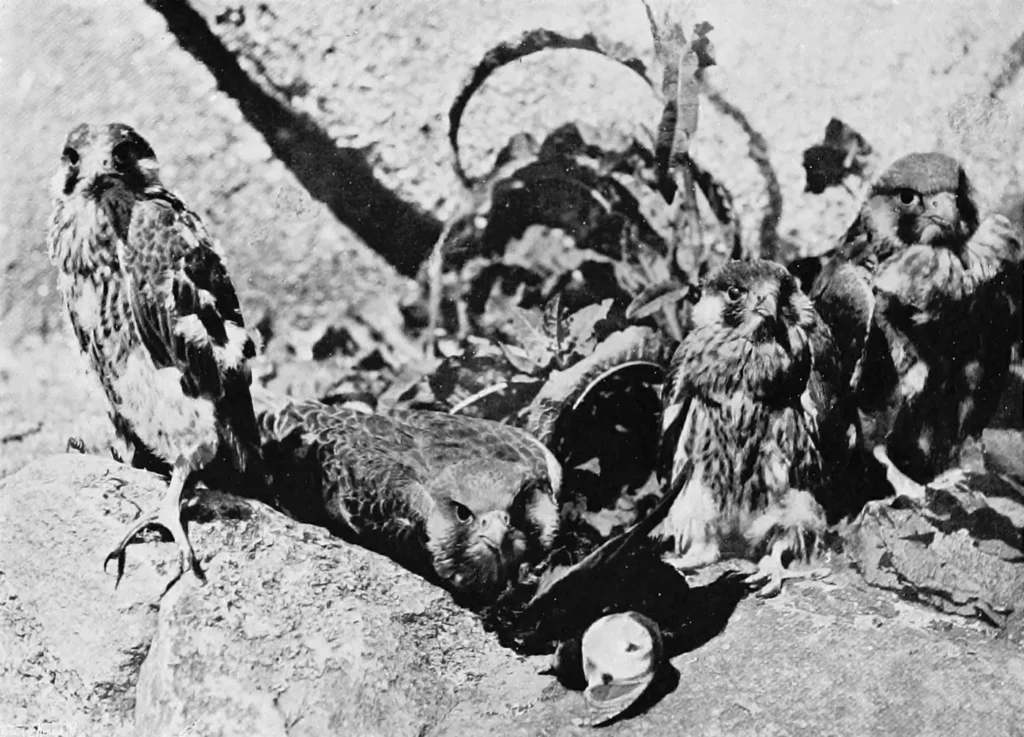
The fourth week produces the most dramatic visual change. Brown body feathers push through the down. The mixture gives the bird a mottled or speckled appearance.
The wing and tail feathers lengthen quickly. The dark malar mark becomes recognizable. Vertical streaks begin to show across the buff breast and belly. Patches of white down remain on the head, shoulders, back, and legs.
Young peregrines at this age flap and run across the ledge. They are strengthening the flight muscles, but they are not ready for controlled flight. A four-week-old bird on the ground below a nest may have fallen or fledged prematurely.
29 to 35 Days: Mostly Brown, With Down Patches Remaining
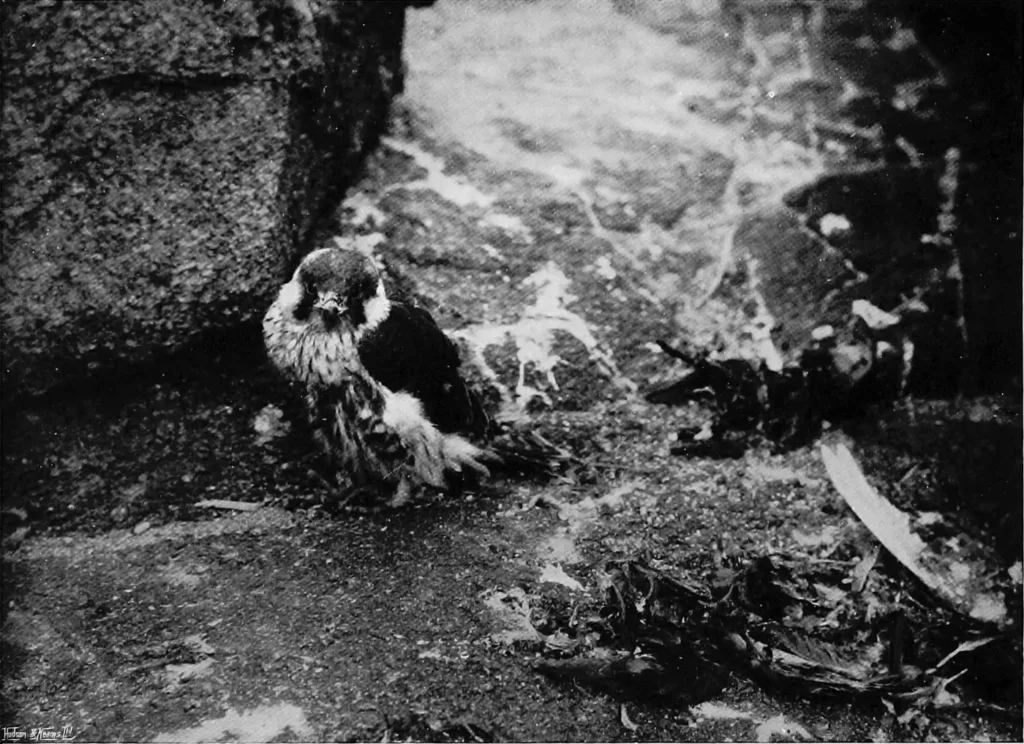
By the fifth week, the bird looks much more like a juvenile peregrine. Brown upperparts cover most of the back. The underparts show strong vertical streaks. The folded wings are long, although the flight feathers may still be growing.
Small islands of white down often cling to the crown, shoulders, wing coverts, or feathered upper legs. These patches help distinguish a late nestling from a fully fledged bird. The remaining down can disappear quickly through preening and normal feather growth.
The bird may walk away from the nest scrape and perch on nearby ledges. This behavior is often called ledge walking. It should not automatically be described as fledging. Fledging means the bird has made its first flight.
35 to 42 Days: Fledging Condition
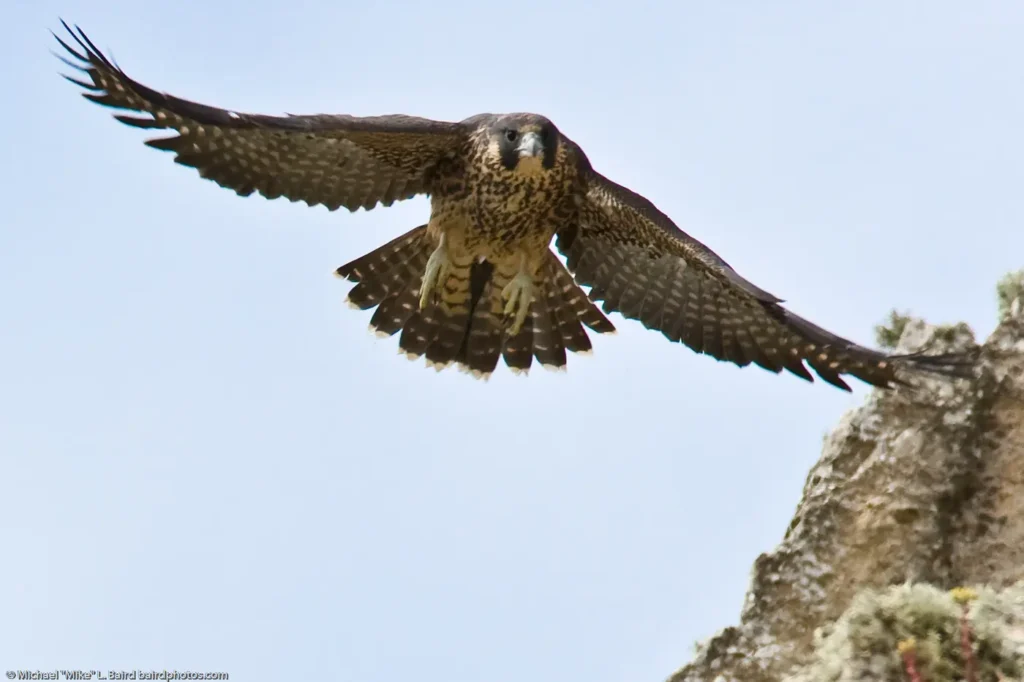
Most peregrines reach fledging condition during this period. The bird is nearly or completely covered in juvenile feathers. The wings appear full and pointed. The tail has gained length, although it can still look slightly short on a newly fledged bird.
A trace of down may survive on the head or legs. Some individuals leave the ledge with a little down still visible. Others look cleanly feathered before their first flight.
New fledglings often appear hesitant. They flap vigorously, make short flights, and land awkwardly. Poor landing control is normal. A fledgling sitting on a low roof, balcony, or open ground is not necessarily injured. Its condition and immediate danger matter more than its low position.
6 to 10 Weeks: The Newly Independent-Looking Fledgling
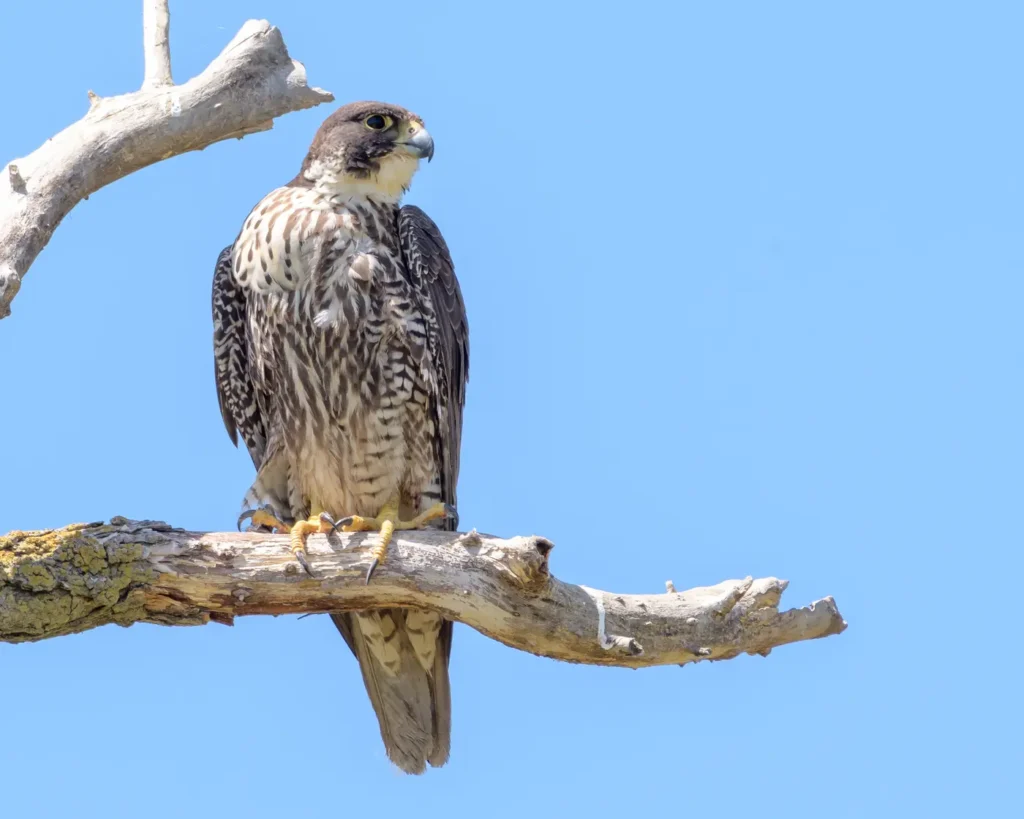
A six- to ten-week-old peregrine is fully dressed in juvenile plumage. It has dark-brown upperparts, buff-edged wing coverts, a patterned face, and dense vertical streaks below. Its cere and eye-ring are usually still cool blue-gray or muted rather than bright adult yellow.
Flight improves rapidly. Young birds chase siblings, practice aerial turns, and attempt prey transfers from their parents. They may look independent while still relying on adults for food.
Behavior can reveal this age better than plumage. Repeated begging, following adults, clumsy landings, and play-like pursuits near a known nest point to a recent fledgling. The same plumage on a solitary migrant later in the year cannot be assigned such a narrow age.
Late Summer Through the First Winter: Juvenile Plumage Persists
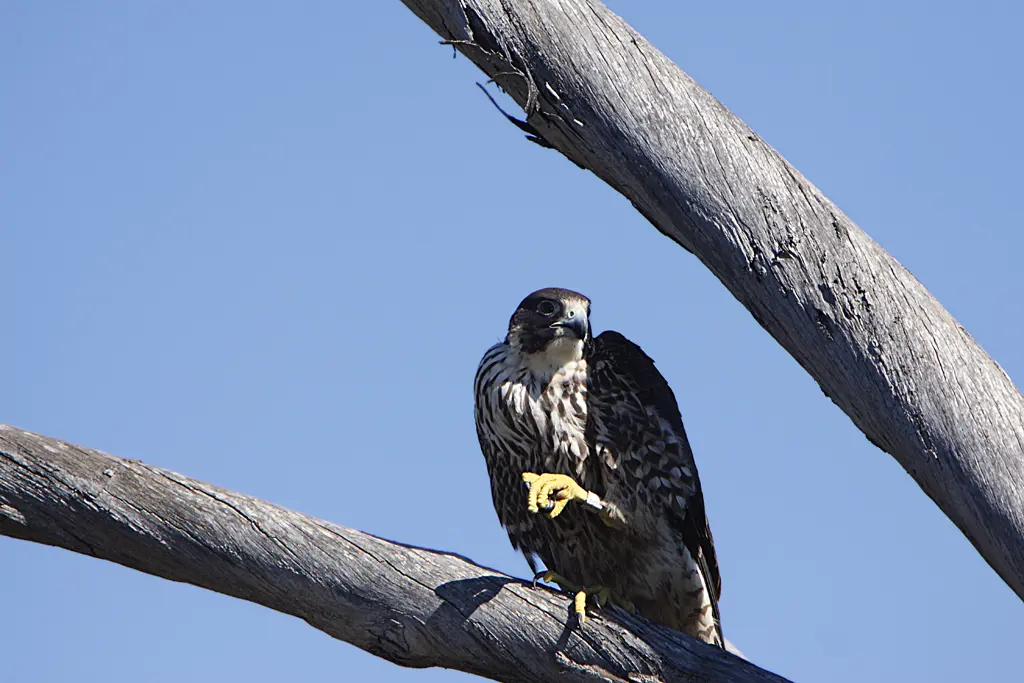
The brown-and-streaked appearance remains through the first autumn and winter. Fresh buff margins gradually abrade. The upperparts may become more uniformly brown. Underpart streaks can look sharper or more exposed as pale feather edges wear.
The cere, orbital ring, legs, and feet often shift from bluish or muted tones toward yellow during the first winter. This transition varies. A young bird with fairly yellow feet can still retain fully juvenile plumage.
Once peregrines disperse, calendar age is hard to judge closely. A photographed bird might be five months old or ten months old and show nearly the same basic pattern. Without a band, hatch record, active nest, or documented molt, a precise month is usually an estimate.
About 10 to 13 Months: The First Adult-Type Feathers Appear
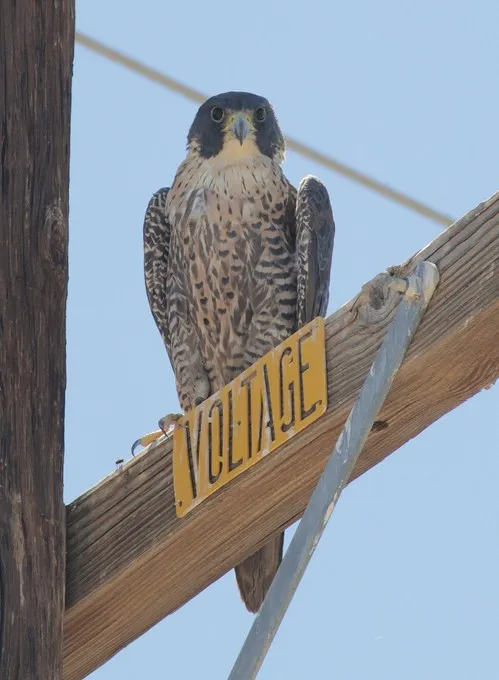
The first major molt usually begins around the bird’s first spring and summer. Gray adult-type feathers start replacing brown juvenile feathers above. Horizontal barring begins replacing vertical streaks below.
The result can look untidy. Brown and gray feathers may sit beside one another. The breast and belly can contain a mixture of streaked juvenile feathers and barred adult-type feathers. Flight feathers are not all replaced at once, so the wings and tail may also show two generations of feathers.
This is better described as a first-molt or subadult peregrine than a straightforward juvenile. The bird is entering adult plumage, but it may not yet look uniformly blue-gray and barred.
Second Calendar Year and Beyond: Nearly Adult Appearance
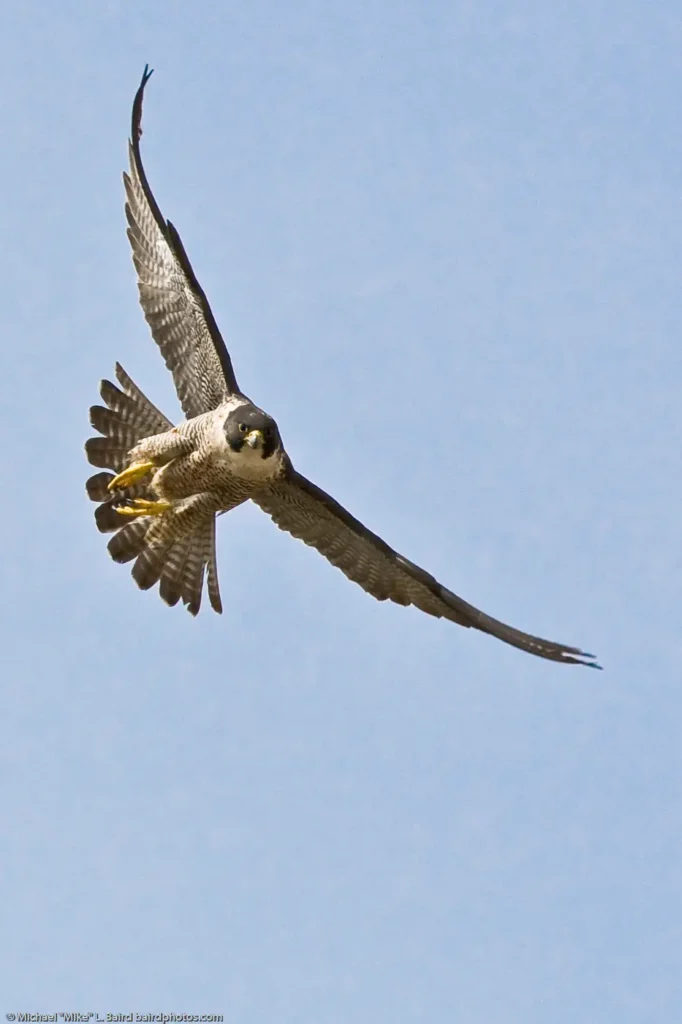
After the first molt, most of the obvious juvenile pattern has disappeared. A second-year bird may retain a few brown or streaked feathers. These can be difficult to see without a sharp photograph.
Once full adult plumage is present, appearance cannot reveal an exact age. A two-year-old and an older adult may look essentially alike. Band history is the only dependable way to establish the precise age of such a bird.
Juvenile Versus Adult Peregrine Falcon
The direction of the markings is the quickest comparison. Juveniles are streaked lengthwise. Adults are barred crosswise across the belly and flanks.
An adult also has blue-gray upperparts and a cleaner, more helmeted head. Its cere, orbital ring, legs, and feet are normally brighter yellow. The upper breast may be white, buff, or spotted depending on the bird and subspecies.
A juvenile is browner and more textured. Pale feather edges can create a scaled back. Its face often shows a distinct pale eyebrow around a broad brown-black cheek patch. In poor light, an adult can look brown. Confirm the underpart pattern before assigning age.
How Juvenile Plumage Varies by Region
Peregrine Falcons occupy every continent except Antarctica. Their plumage varies geographically. A field mark that works on one population may be less obvious in another.
In North America, tundra-breeding juveniles are often relatively pale. They may show a pale crown and lighter underparts with narrower streaks. Interior birds are commonly warmer and more heavily marked. Juveniles from the wet Pacific coast can be extremely dark above and densely streaked below.
Similar variation occurs elsewhere. Some peregrines are small and dark. Others are pale-headed or lightly marked. A broad malar mark is characteristic, but its width and connection to the crown vary.
This variation is why a juvenile peregrine should be identified through a package of features. Structure, flight, facial pattern, and vertical streaking are more dependable together than any exact shade of brown.
Juvenile Peregrine Falcon in Flight
At a distance, shape becomes more useful than feather detail. A peregrine has long, pointed wings attached to a deep chest. The wing base is broad, while the outer wing narrows to a sharp tip. The tail looks moderate or fairly short in fast flight.
Wingbeats are strong, shallow, and purposeful. A traveling peregrine often alternates rapid beats with brief glides. It can accelerate without the buoyant, fluttering quality of a kestrel.
Young birds can be less polished. A recent fledgling may use deeper or less even wingbeats. It may circle a nest building, chase siblings, or miss a landing. The underlying pointed-wing silhouette remains.
Do not use a high-speed dive as a required field mark. Peregrines are famous for stooping, but many observations involve level travel, circling, perching, or low pursuit. Juveniles also spend considerable time practicing rather than executing clean hunting dives.
Common Juvenile Peregrine Misidentifications
Brown plumage and a streaked breast occur in many raptors. The best comparison depends on location, habitat, and the bird’s size.
Juvenile Peregrine Falcon vs Prairie Falcon
This is the most important comparison in western North America. A juvenile Prairie Falcon is usually paler and sandier. It has a whiter cheek, a pale eyebrow, and a narrower dark moustache. A juvenile peregrine normally looks darker, more hooded, and more powerfully built.
In flight, look at the underwing. Prairie Falcons show dark axillary patches near the wing base. These dark armpits can be decisive. Peregrines lack the Prairie Falcon’s sharply defined black axillary wedges.
Do not rely on habitat alone. Prairie Falcons favor dry open country, while peregrines are often associated with coasts, wetlands, cities, and cliffs. Both can wander outside those typical settings.
Juvenile Peregrine Falcon vs Merlin
A Merlin is smaller and more compact. It has a shorter-winged look, a strongly banded tail, and usually a less commanding malar mark. Size overlap can cause problems because female Merlins are large and male peregrines are small.
Watch proportions. A peregrine has a heavier chest, larger head, and longer pointed wings. A Merlin often looks dashing and compact, with fast, stiff wingbeats. It can resemble a reduced peregrine, but the tail pattern and weaker facial contrast usually expose it.
Juvenile Peregrine Falcon vs Gyrfalcon
A Gyrfalcon is larger, longer-tailed, and broader-winged. Its wingtips look less sharply drawn than a peregrine’s. Gyrfalcons range from white to dark gray-brown, so color is not a safe shortcut.
Many Gyrfalcons have a paler, less helmeted face and a weaker malar mark. Their flight often looks powerful and steady rather than tight and sharply accelerated. In areas where both occur, structure should carry more weight than plumage shade.
Juvenile Peregrine Falcon vs Saker Falcon
Saker Falcons have broader wings, a longer tail, and a paler head. Their malar stripe is usually narrower or less solid. The overall shape can feel longer and less compact than a peregrine.
Hybrids and captive-origin falcons complicate this comparison in some regions. A bird with mixed characters, unusual equipment, or atypical behavior may require expert review. A clear series of photographs is more valuable than one tightly cropped portrait.
Juvenile Peregrine Falcon vs Cooper’s Hawk
A juvenile Cooper’s Hawk also has brown upperparts and vertical streaks below. Its structure is completely different. The Cooper’s Hawk has rounded wings and a long, broadly banded tail. It lacks the peregrine’s strong malar mark.
In flight, a Cooper’s Hawk often uses a flap-flap-glide rhythm. A peregrine looks more pointed, compact, and direct. When perched, the hawk’s long tail extends conspicuously below the folded wings.
Juvenile Peregrine Falcon vs American Kestrel
An American Kestrel is much smaller and slimmer. It has two dark facial slashes rather than one broad peregrine sideburn. Rusty upperparts, spotting, and a bold tail pattern further separate it.
Kestrels frequently hover. Peregrines can hold position briefly in strong wind, but sustained kestrel-like hovering is not typical. Apparent size can be deceptive in an empty sky, so confirm facial pattern and proportions.
A Practical Identification Sequence
Begin with silhouette. Decide whether the bird has pointed falcon wings or rounded hawk wings. Then assess size and proportions. A peregrine should look crow-sized, deep-chested, and substantial, although males are noticeably smaller than females.
Next, examine the face. Look for a broad malar mark, dark crown, and contrasting pale cheek. Move to the underparts. Long vertical streaks support juvenile age. Horizontal barring supports adult or adult-type plumage.
Finally, check the upperparts and soft parts. Brown, buff-edged feathers fit a juvenile. Blue-gray feathers fit an adult or molting subadult. Blue-gray cere and orbital skin strengthen a juvenile assessment, while yellow soft parts need to be interpreted alongside plumage.
Use behavior and habitat as confirmation. They should never override contradictory anatomy. If only one feature is visible, record the bird as a probable peregrine rather than forcing certainty.
Photographing a Juvenile for Identification
A side portrait is useful, but it does not capture every diagnostic feature. Try to photograph the bird from several angles without approaching a nest ledge or disturbing it.
The most useful set includes a full side view, a front view of the streaking, an open-wing image from below, and a frame showing the tail. Keep uncropped versions. They preserve scale, habitat, and proportions that can disappear in a tight edit.
Record the date and location. Note whether adults were present, whether the young bird begged, and how it flew. These observations can separate a recent fledgling from an older first-year bird with similar plumage.
What to Do if You Find a Young Peregrine on the Ground
A grounded fledgling is not automatically abandoned. Young peregrines sometimes land below their nest during early flight attempts. Adults may continue watching and feeding them.
Observe from a safe distance. Keep people and pets away. If the bird is alert, standing normally, and not in immediate danger, contact a local wildlife rehabilitator, raptor organization, or wildlife authority for instructions before moving it.
Urgent help is appropriate when the bird is bleeding, has a drooping wing, cannot stand, is trapped, or is exposed to traffic or predators. Do not offer food or water. Do not attempt to return it to a high ledge yourself.
Conclusion
Reliable juvenile peregrine falcon identification comes from combining structure and plumage. The strongest package is a deep-chested falcon with pointed wings, brown upperparts, a broad dark malar mark, and dense vertical streaking below.
Age can be narrowed closely while feathers are developing in the nest. After fledging, precision drops. Soft-part color, feather wear, molt, behavior, and context can refine the estimate, but they do not always produce an exact month. When the evidence is incomplete, a careful probable identification is better than false certainty.
FAQs
How can you tell if a Peregrine Falcon is a juvenile?
Look for brown upperparts, buff-edged feathers, heavy vertical streaking below, a broad dark malar mark, and often a bluish-gray cere or eye-ring. Confirm the pointed-winged, deep-chested peregrine shape.
How long does a Peregrine Falcon keep juvenile plumage?
The brown-and-streaked plumage normally lasts through the first autumn and winter. Adult-type feathers begin appearing during the first major molt around the following spring and summer, often near the bird’s first birthday.
Are juvenile Peregrine Falcons larger than adults?
No. Sex creates the major size difference. Females are substantially larger than males at every age. A juvenile can look bulky because fresh feathers are full and its posture is less sleek.
Do juvenile Peregrine Falcons have yellow feet?
Young birds often begin with bluish, grayish, or muted soft parts. The feet, legs, cere, and eye-ring become yellower with age. The timing varies, so yellowish feet do not automatically make a bird an adult.
Do young Peregrine Falcons have a white head?
Nestlings have white down. Late nestlings may retain small down patches on the crown or body. A fully fledged juvenile has a brown, patterned head rather than a white one, although some subspecies show a noticeably pale crown or eyebrow.
Can a juvenile Peregrine Falcon fly?
Yes. Juvenile describes plumage, not inability to fly. Peregrines usually make their first flight at roughly five to six weeks old and retain juvenile plumage for many months afterward.
Is a brown Peregrine Falcon always a juvenile?
Usually, a clearly brown and vertically streaked peregrine is a first-year bird. Poor light can make adults appear brown, and a molting bird can show mixed brown and gray feathers. The underpart pattern and soft parts help confirm age.
Can you identify the exact age of a fledged Peregrine Falcon from a photo?
Usually not. Recent fledglings near a known nest can be aged approximately through behavior, down remnants, and feather growth. Once fully feathered, several months of the first year overlap in appearance. A band or known hatch date is needed for precision.