

What do prairie falcons eat? Prairie falcons mainly eat ground squirrels and other small mammals during the warmer months. Birds such as Horned Larks and Western Meadowlarks often become more important in winter. Their exact menu changes with season, habitat, prey activity, and location. This broad seasonal pattern is described by the Cornell Lab of Ornithology.
That flexibility allows the species to hunt across much of western North America. A pair nesting above Idaho shrub-steppe may rely heavily on ground squirrels. A wintering falcon over a wheat field may pursue flocking larks. A desert pair may bring reptiles to its young, while a bird near a saline lake may capture shorebirds. There is no single prey list that fits every prairie falcon in every month.
The Short Answer: What is a Prairie Falcon’s Main Food?
Small mammals are often the most important prey during the breeding season. Ground squirrels are especially valuable because they are active in daylight, live in open terrain, and provide a substantial meal. Both Audubon and the Cornell Lab identify ground squirrels as major warm-season prey.
Birds gain importance when burrowing mammals are scarce or remain underground. This change is most noticeable in winter. Ground squirrels become less accessible, while Horned Larks, meadowlarks, starlings, doves, and other birds remain visible above ground. Some local populations also take many birds during the nesting season, so it is more accurate to describe a shift in emphasis than a complete switch.
Prairie falcons are adaptable carnivores, but they are not indiscriminate. They favor animals that can be located and overtaken in open country. Dense woodland prey may be abundant yet difficult for this falcon to pursue. A smaller population of exposed prey can therefore matter more than a larger population hidden by vegetation or underground.
| Prey group | Typical examples | When it matters most |
| Small mammals | Ground squirrels, chipmunks, mice, voles, kangaroo rats, woodrats, pikas, and young rabbits | Often most important in spring and summer around breeding territories |
| Birds | Horned Larks, Western Meadowlarks, sparrows, longspurs, lark buntings, starlings, doves, and shorebirds | Taken year-round and often especially important in winter |
| Reptiles | Horned lizards, whiptails, collared lizards, chuckwallas, and occasionally snakes | Warm periods in arid habitats |
| Invertebrates | Grasshoppers, crickets, beetles, and occasionally other large invertebrates | Supplemental prey, especially when locally abundant or pursued by juveniles |
Small Mammals in the Prairie Falcon Diet
The close association between prairie falcons and ground squirrels is not accidental. Prairie falcons breed in dry, open country where burrowing mammals can be abundant. The cliffs and rocky outcrops that provide nest ledges may also overlook extensive hunting ground. A falcon can scan this terrain, approach at low altitude, and reach a squirrel before it returns to its burrow.
Ground squirrel species differ across the range. Townsend’s, thirteen-lined, Richardson’s, and other locally abundant ground squirrels can fill the same ecological role. What matters is their size, daylight activity, and exposure on open ground. Adult squirrels create an early-season food source after they emerge. Later, young squirrels begin appearing near burrow entrances. That pulse of inexperienced prey can overlap with the period when falcon nestlings require frequent deliveries.
A four-year study at nesting territories in northeastern Wyoming shows how dominant one local prey species can become. Thirteen-lined ground squirrel remains appeared in 91% of the pellets examined. This does not mean the squirrels formed 91% of every meal or 91% of total biomass. Pellet occurrence, prey count, and biomass are different measures. The result nevertheless shows how heavily a nesting population can use an abundant daylight-active rodent. The data and limitations are available in the original Journal of Raptor Research paper hosted by the USDA Forest Service.
Prairie falcons also take chipmunks, pocket gophers, mice, voles, kangaroo rats, woodrats, and other small rodents. These prey may become more important when ground squirrel numbers fall or when a falcon hunts terrain where another mammal is easier to expose. A pocket gopher that rarely leaves its tunnel is less available than its local abundance suggests. A mouse crossing bare soil at dawn or dusk is more vulnerable.
Pikas are documented in the summer diet and may be taken in alpine or talus habitat, as noted by the Cornell Lab. Their importance is local rather than universal. High-elevation diet data are limited, and a prairie falcon seen above the tree line should not automatically be described as a pika specialist.
Young cottontails and small rabbits are also possible prey. Large adult jackrabbits are too heavy and risky to be routine targets, even though Audubon notes that prairie falcons can sometimes kill prey approaching jackrabbit size. Killing capacity is not the same as carrying capacity. A large item may be eaten where it falls or moved only a short distance, while smaller prey can be carried efficiently to a nest.
Birds Eaten by Prairie Falcons
Birds are not merely emergency food. They may form a substantial share of the diet in some places even during nesting. Their importance depends on which species gather in open areas and how easily the falcon can separate one bird from a flock. Flight behavior, cover, wind, and the angle of attack can matter as much as simple abundance.
Grassland Birds and Winter Flocks
Horned Larks are among the best-known winter foods of prairie falcons. They forage and travel across short grass, desert flats, winter fields, and other open ground. Those habits expose them to a predator that approaches low and fast. Cornell’s Bird Academy describes prairie falcons moving toward the Great Plains to exploit abundant wintering Horned Larks in its raptor migration lesson.
Western Meadowlarks offer a larger meal. In the northeastern Wyoming pellet study, meadowlark remains occurred in 56% of samples and Horned Lark remains in 23%. The figures describe one breeding population, not a range-wide formula. They are valuable because they show that birds can remain significant even where ground squirrels are heavily used.
Other grassland prey includes lark buntings, longspurs, sparrows, pipits, and blackbirds. Flocks concentrate opportunities, but the falcon does not always take the most numerous species. A larger meadowlark may provide a better energetic return than a small sparrow. A compact flock may also detect an approaching predator sooner than scattered birds. Prairie falcons continually balance the value of a potential meal against pursuit time, escape cover, and the risk of a failed attack.
Doves, Farmland Birds, Shorebirds, and Larger Prey
Mourning Doves are documented prey in parts of California and Utah. European Starlings may be useful winter food near feedlots, farm buildings, irrigated cropland, and towns. Grain, livestock feed, disturbed soil, and water can concentrate birds in exposed areas. Prairie falcons may also take pigeons, quail, and similar birds when local conditions favor an attack, but those species should not be presented as equal staples across the range. The Cornell Lab’s life-history account provides the clearest institutional support for Mourning Doves in the breeding diet.
Prairie falcons sometimes hunt shorebirds around lakes, reservoirs, marsh margins, and agricultural wetlands. The falcon uses the open airspace around water rather than feeding like a fish-eating raptor. A shorebird flushed away from cover can be pursued in the air or driven toward the ground. This pattern can be locally important, yet it does not define the diet across the species’ largely dry interior range.
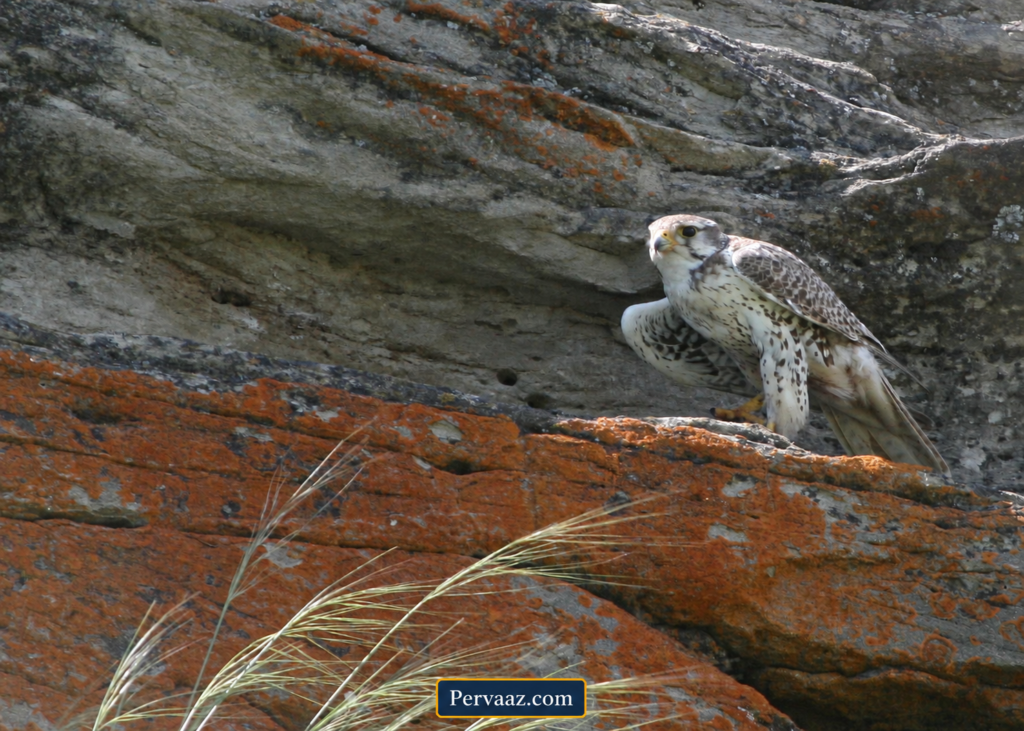
The species is capable of killing relatively large birds. Audubon’s account mentions prey up to grouse size. Capability should not be confused with normal frequency. Larger prey is harder to subdue, exposes the falcon to injury, and may be difficult to transport. Reports of attacks on geese, full-grown poultry, or other raptors can be genuine exceptional events without representing the everyday diet.
Reptiles and Invertebrates as Supplemental Prey
Prairie falcons do eat reptiles, particularly in warm desert environments. Documented prey in the Mojave Desert includes whiptails, collared lizards, spiny lizards, chuckwallas, and snakes. These records are summarized in the peer-reviewed paper “Prairie Falcon Prey in the Mojave Desert, California”.
Reptiles are usually less important than mammals and birds across the full range. Local exceptions can be striking. The Mojave paper cites a historical nest account in which young were reportedly raised entirely on reptiles, mainly chuckwallas. One nest cannot establish a regional percentage. It does show how strongly a pair may respond to an unusual concentration of accessible prey.
Temperature controls reptile availability. A sun-warmed lizard on an exposed rock is a realistic target. The same animal hidden in a crevice during cool weather is effectively absent from the falcon’s menu. This helps explain why reptiles are more prominent in warm deserts and during warm parts of the year.
Grasshoppers and other large insects are supplemental food. Audubon and the Cornell Lab include insects in the species’ diet, but neither describes them as a major long-term food source for adults. An insect provides far less energy than a squirrel or meadowlark, so an adult would need many more captures to meet the same need.
Recently fledged prairie falcons may pursue insects while learning to hunt. A grasshopper is easier and safer to chase than a fast bird or defensive mammal. These attempts can provide small meals while also developing timing, foot placement, and control close to the ground. The behavior is therefore useful without making insects the defining food of juvenile falcons.
Prairie Falcon Diet by Season
Season changes what is available more than it changes the falcon’s underlying hunting style. Prairie falcons continue to favor open-country prey that can be surprised, overtaken, or pinned to the ground. What changes is the mix of animals exposed above ground and the amount of food a breeding pair must deliver.
![what do prairie falcons eat [infographic]](https://pervaaz.com/wp-content/uploads/what-do-prairie-falcons-eat-infographic-683x1024.png)
Spring and Summer
The return of ground squirrels to the surface can create an important spring food pulse. Adults are defending territories, laying eggs, incubating, and beginning to feed young at the same time. The timing varies with latitude, elevation, snow cover, temperature, and the biology of the local squirrel species. Birds remain relevant during this transition, especially before mammals become consistently active.
Ground squirrels often dominate in summer where colonies are productive. Newly emerged juvenile squirrels increase the supply of vulnerable targets. Other rodents, birds, reptiles, and large insects broaden the menu. The composition at a particular nest may change from week to week as prey emergence, vegetation, and weather alter what adults can catch.
Food demand peaks as the nestlings grow. The male performs much of the hunting during incubation and early brooding, while the female receives prey and feeds the young. Audubon reports that the female remains with the young for roughly the first four weeks and may then begin hunting; its breeding account also notes the male’s provisioning role. This division affects what reaches the eyrie, but it does not create separate male and female diets.
Fall and Winter
The menu becomes more mixed in late summer and fall. Ground squirrels spend less time above ground, young falcons disperse, and migrating birds can form temporary concentrations. Juveniles experiment with insects, mammals, and birds as their flight skills improve. Prairie falcons may wander widely after breeding, so an individual can encounter several different prey communities within a short period.
Birds usually become more prominent in winter. Horned Larks and Western Meadowlarks are important in grassland, sage scrub, winter wheat, and other open agricultural landscapes. Starlings may concentrate around cattle feedlots or farm structures. A flock can support repeated hunting attempts, although success still depends on concealment, wind, and the birds’ response.
The winter change is not a complete mammal-to-bird switch. Mice, voles, and other small mammals are still captured when they remain accessible. The central difference is that many ground squirrels are underground while flocks of birds remain active and visible. The falcon adjusts to the best opportunities rather than abandoning one prey category entirely.
How Habitat Changes What Prairie Falcons Eat
A prey list becomes more useful when it is tied to place. Prairie falcons occupy shrub-steppe, grassland, desert basins, agricultural edges, rocky alpine areas, and open country near water. Each landscape offers different prey and different levels of visibility. The falcon’s diet reflects both factors.
Dry Shrub-Steppe, Desert, and Rangeland
Ground squirrels and other rodents are frequent opportunities in shrub-steppe and open rangeland. Horned Larks, meadowlarks, lark buntings, sparrows, and other grassland birds add avian prey. Lizards become more relevant in hot desert areas. Sparse vegetation lets a falcon approach low, but burrows, rocks, and taller shrubs still give prey places to escape.
Cliffs, buttes, power structures, fence posts, and isolated rock outcrops provide observation points. The presence of a perch does not guarantee a productive territory. A nest cliff surrounded by dense vegetation or depleted prey habitat may be less valuable than a modest ledge overlooking active ground squirrel colonies and open hunting lanes.
Local productivity can change sharply between years. Drought, disease, grazing, fire, and rodent-control programs can alter prey numbers or exposure. A falcon may remain in the same broad habitat while shifting from one rodent species to birds or reptiles. This is why habitat labels should guide expectations without being treated as fixed menus.
Farmland, Feedlots, and Water Edges
Agricultural areas can concentrate Horned Larks, starlings, doves, blackbirds, pigeons, and rodents around crops, spilled grain, livestock feed, irrigation, and disturbed soil. Open fields suit low surprise attacks. Harvesting can temporarily expose mammals that were previously hidden by vegetation. Feedlots may keep birds available during winter, when native burrowing mammals are less accessible.
These benefits are uneven. Intensive land conversion can remove native prey habitat even while creating short-term concentrations of a few adaptable birds. Rodent control may reduce prey supply and can expose raptors to toxic compounds. A productive agricultural hunting area therefore depends on how the land is managed, not simply on the presence of crops or livestock.
Reservoirs, marsh edges, and saline lakes add shorebirds, small waterbirds, doves, and nearby grassland species. Prairie falcons exploit open flight space and exposed shoreline rather than catching fish. Water can act as a prey-concentration feature inside a dry landscape, especially during migration. Its value falls when dense vegetation gives birds immediate cover or when the available species are too large or aquatic for the falcon’s normal hunting methods.
Alpine Tundra and Talus
High-elevation territories offer a different menu. Pikas, other small mammals, and alpine birds may replace many lowland species. Open rock fields can suit a prairie falcon’s visual hunting style, while continuous forest does not. Talus provides both prey and escape cover, so success depends on catching an animal away from a crevice.
Diet evidence from alpine territories is less extensive than evidence from several grassland and shrub-steppe populations. Pikas should therefore be presented as documented possible prey, not as the automatic staple of every mountain falcon. A high-elevation bird may still rely heavily on birds or other mammals when those prey are more exposed.
Season is especially influential at elevation. Snow cover, delayed mammal activity, and short breeding seasons compress the period when prey is easy to reach. Falcons using these areas may move to lower or more open winter landscapes where birds remain available. The habitat shift and the diet shift are often connected.
How Prairie Falcons Hunt and Handle Food
The prey list is shaped by the way prairie falcons hunt. Speed matters, but surprise, terrain, and timing are just as important. A fast falcon that reveals its approach too early may still lose a squirrel to a burrow or a lark to a tight flock.
Low Attacks, Aerial Pursuit, and Perch Hunting
A prairie falcon may fly only a few feet above the ground and follow the contours of the terrain. Ridges, shrubs, and small rises hide its approach until the last acceleration. The Cornell Lab describes these low “strafing” flights at heights of about 10 feet in its life-history account. The tactic works on squirrels feeding away from their burrows and on birds using open fields.
Bird prey may also be struck in the air or forced toward the ground. A falcon can rush a flock, cause individuals to scatter, and focus on one target. It may stoop from above when position and wind are favorable. These methods are not separate menu choices. They are different ways of exploiting the same open-country vulnerability.
Perch hunting reduces energy use. Rocks, posts, utility structures, and cliff faces offer wide views of prey movement. The falcon can wait for a rodent to leave cover or for a flock to change direction before launching. Perches are most useful when they overlook exposed travel routes rather than simply being the highest objects in the landscape.
Caching, Theft, and the Limits of Carrion Use
Breeding prairie falcons may cache surplus prey in vegetation or rocky places. A cache can bridge a period of poor weather or failed hunts and may reduce the need to expose the nest to repeated arrivals. The Cornell Lab reports that males and females use separate cache sites. Stored prey also explains why a falcon’s food intake cannot be reduced to a simple number of kills per day.
Prairie falcons sometimes steal prey from other raptors. HawkWatch International reports winter theft from harriers, Rough-legged Hawks, and other raptors. Kleptoparasitism can provide a meal when conditions favor it, but active hunting remains the normal method of obtaining food.
Carrion use appears rare and is not documented well enough to describe prairie falcons as routine scavengers. Unusual material in a pellet may also have come from the stomach of captured prey rather than from carrion eaten directly. An isolated observation or pellet fragment cannot establish a regular feeding strategy.
Nestling Food, Parental Roles, and Daily Intake
Baby prairie falcons eat the same prey species captured by the adults. They do not require a separate category of food. When the chicks are small, the female tears flesh into manageable pieces and feeds them individually. Feathers, large bones, fur, feet, and other difficult parts may be removed, swallowed in limited amounts, or left uneaten.
As nestlings grow, they begin pulling at carcasses and feeding themselves. After fledging, parents may continue delivering food while the young improve their flight and hunting skills. A fledgling chasing insects can be practicing, eating, or doing both. Dependence ends gradually rather than on the day of the first flight.
The male supplies much of the food during incubation and early brooding, while the larger female remains at the nest. Later, the female may hunt more often. Both sexes use the same broad prey categories. Differences in body size and breeding duty may influence the size or timing of deliveries, but the evidence does not support two distinct sex-specific diets.
There is no dependable fixed answer to how much a prairie falcon eats each day. A ground squirrel provides far more food than a grasshopper or small sparrow. Requirements change with body size, temperature, activity, and breeding status. A pair feeding several growing chicks must capture much more than a nonbreeding adult. Large kills and caches also let a falcon eat from one item over more than one feeding period, making a universal daily number misleading.
How Researchers Identify Prairie Falcon Prey
Researchers reconstruct diets from pellets, prey remains, direct observation, and nest cameras. Each method sees a different part of the feeding process. Pellets contain indigestible fur, feathers, bones, and teeth. They can confirm prey identity, but they do not convert cleanly into the number of animals consumed or their contribution to total biomass.
Soft-bodied prey may be underrepresented in remains. Large prey can be overrepresented because it leaves more identifiable material. Cameras record items delivered to a nest, not everything adults eat elsewhere. Direct observation is valuable but favors visible hunts and is limited by distance, terrain, and observer time. The strongest conclusions come from several methods used together.
This distinction matters when reading percentages. A species found in 91% of pellets occurred often across samples. That does not mean it provided exactly 91% of all prey items, calories, or biomass. Good diet reporting states the measure, location, season, sample size, and study period rather than turning one local number into a universal rule.
Researchers also need to separate availability from preference. A falcon may capture many ground squirrels because they are abundant and exposed, not because it refuses other prey. A change in the observed menu can reflect prey behavior, weather, vegetation, or breeding demands even when the falcon’s basic hunting preferences remain stable.
Why Prey Availability Matters to Breeding and Conservation
A secure cliff is only one part of a usable nesting territory. The surrounding landscape must allow adults to find and deliver enough prey. When exposed mammals or birds are scarce, adults spend more time and energy hunting. Long trips can reduce feeding frequency and leave the nest less guarded.
Prey abundance alone is not enough. Animals must be accessible. Dense vegetation, loss of open foraging ground, or changes in grazing can reduce hunting efficiency without eliminating the prey population. A regional conservation assessment recommends maintaining prey habitat around nesting areas; see the New Mexico Avian Conservation Partners prairie falcon assessment.
Rodent control can affect prairie falcons in two ways. It may remove a major food source, and some toxicants can move through the food chain. Risk depends on the active ingredient, placement, and use pattern. The U.S. Fish and Wildlife Service notes poisoning of diurnal and nocturnal raptors by anticoagulant rodenticides, especially brodifacoum, in its programmatic environmental impact statement. That evidence supports caution without implying that every control program creates the same hazard.
Conservation decisions should therefore consider nesting ledges, open hunting structure, prey populations, and chemical exposure together. Protecting a cliff while degrading the surrounding foraging landscape may preserve a nest site on paper without preserving a productive breeding territory.
Conclusion
Prairie falcons eat the prey their open-country hunting style allows them to catch efficiently. During spring and summer, this often means ground squirrels and other small mammals. During winter, Horned Larks, meadowlarks, starlings, doves, and other birds usually become more prominent. Reptiles and insects supplement the menu where climate and habitat make them available.
The most accurate answer is seasonal and local. Habitat determines which animals are present. Weather and prey behavior determine which are exposed. Breeding determines how much food must be delivered. The prairie falcon responds by shifting its menu while remaining a fast, adaptable predator of western open country.
FAQs
What Is a Prairie Falcon’s Main Food?
Ground squirrels are the main warm-season food of prairie falcons in many breeding areas. They are active during daylight, live in open habitats, and provide enough food to justify the energy used during a hunt. Both the Cornell Lab of Ornithology and Audubon identify ground squirrels as important prey.
There is no single main food throughout the year. Birds often become more important in winter, when many ground squirrels remain underground. Habitat and local prey availability also influence which species are captured most frequently.
Do Prairie Falcons Eat Ground Squirrels?
Yes. Ground squirrels are among the most important prey animals for prairie falcons, especially during spring and summer. Different ground squirrel species fill this role in different regions.
One study of nesting prairie falcons in northeastern Wyoming found thirteen-lined ground squirrel remains in 91% of the pellets examined. This percentage describes how often the remains appeared in samples. It does not mean ground squirrels represented exactly 91% of all prey or food biomass. The complete findings are available in the Journal of Raptor Research study hosted by the USDA Forest Service.
Do Prairie Falcons Eat Prairie Dogs?
Prairie falcons may be physically capable of killing a very young or unusually small prairie dog. However, prairie dogs are not established as regular prey across the species’ range.
Ground squirrels are smaller, easier to carry, and far better documented in prairie falcon diet studies. Online prey lists sometimes group all burrowing rodents together, but prairie dogs and ground squirrels are not interchangeable. Unless a reliable observation identifies a prairie dog, it is safer to describe burrowing mammal prey as ground squirrels or other small rodents.
Do Prairie Falcons Eat Other Birds?
Yes. Prairie falcons regularly eat birds, especially during winter and in habitats where small mammals are difficult to catch. Common avian prey includes Horned Larks, Western Meadowlarks, sparrows, longspurs, lark buntings, starlings, doves, and some shorebirds.
Horned Larks are particularly important because they gather in open fields and short grass. Western Meadowlarks provide a larger meal. Prairie falcons may also capture birds during the breeding season, so avian prey is not limited to winter. The seasonal difference is a change in importance rather than a complete switch from mammals to birds.
Do Prairie Falcons Eat Pigeons or Chickens?
Prairie falcons can capture pigeons and doves when suitable opportunities arise. Mourning Doves are documented prey in parts of California and Utah, according to the Cornell Lab’s prairie falcon account. Pigeons may be taken locally around farms, towns, and other open developed areas, but they are not a primary food across the falcon’s range.
Domestic chickens are not normal prairie falcon prey. A very small chick could be vulnerable, but attacks should be considered possible exceptions rather than typical behavior. Covered poultry runs provide the most dependable protection from aerial predators.
Do Prairie Falcons Eat Snakes and Lizards?
Yes. Prairie falcons eat lizards and occasionally snakes, particularly in warm desert habitats. Documented Mojave Desert prey includes whiptails, collared lizards, spiny lizards, chuckwallas, and snakes. These records are detailed in the peer-reviewed study “Prairie Falcon Prey in the Mojave Desert, California”.
Reptiles are generally supplemental prey rather than a range-wide staple. Their importance increases when warm temperatures bring them onto exposed rocks or open ground. Cold weather makes reptiles less active and more difficult for falcons to locate.
Do Prairie Falcons Eat Insects?
Yes. Prairie falcons sometimes eat grasshoppers, crickets, beetles, and other large insects. Insects are supplemental food because each capture provides much less energy than a ground squirrel, meadowlark, or dove.
Recently fledged prairie falcons may chase insects more frequently than experienced adults. These pursuits can provide small meals while helping young falcons develop timing, coordination, and control near the ground. Insect hunting should not be interpreted as evidence that insects form the main juvenile diet. Young falcons continue to depend on larger prey supplied by their parents after leaving the nest.
Do Prairie Falcons Eat Fish or Carrion?
Fish are not a normal part of the prairie falcon diet. A prairie falcon hunting near a reservoir, marsh, or lake is more likely to pursue shorebirds, doves, or nearby grassland birds. It does not have the specialized fishing behavior of an osprey.
Prairie falcons obtain nearly all their food by hunting live prey. Carrion use appears rare and is not documented well enough to describe them as regular scavengers. An isolated observation does not establish a normal feeding pattern. Material found in a pellet may also have originated inside the stomach of captured prey.
What Do Baby Prairie Falcons Eat?
Baby prairie falcons eat pieces of the same mammals, birds, reptiles, and insects captured by their parents. They do not require a separate nestling diet. Ground squirrels and other substantial prey can be especially valuable because one capture may feed several chicks.
When the nestlings are small, the female tears flesh into manageable pieces and feeds them individually. As the chicks grow, they begin pulling apart prey and feeding themselves. Parents continue supplying food after fledging while the young improve their flight, handling, and hunting skills.
What Do Prairie Falcons Eat in Winter?
Prairie falcons usually eat more birds during winter. Horned Larks, Western Meadowlarks, starlings, doves, sparrows, and other open-country birds remain active above ground when many ground squirrels are unavailable.
Winter fields, grasslands, desert flats, and feedlots can concentrate these birds and create repeated hunting opportunities. Small mammals do not disappear from the diet. Prairie falcons still catch mice, voles, and other accessible rodents. The winter pattern is therefore more bird-heavy, but it is not an absolute bird-only diet.
What Do Prairie Falcons Eat in Summer?
Prairie falcons often rely heavily on ground squirrels and other small mammals during summer. Adult and recently emerged juvenile squirrels are active above ground at the same time that breeding pairs must feed growing chicks.
Birds, reptiles, pikas, rabbits, and large insects may supplement the summer diet. The exact mix varies by region. A desert pair may deliver more reptiles, while a grassland pair may rely on squirrels and meadowlarks. Summer diet depends on which prey is locally abundant, exposed, and practical to carry to the nest.
How Much Does a Prairie Falcon Eat Each Day?
There is no reliable daily quantity that applies to every prairie falcon. Food requirements change with the bird’s size, activity, temperature, breeding status, and the type of prey captured.
A ground squirrel provides much more food than an insect or small songbird. A breeding pair feeding several chicks must also capture more prey than a nonbreeding adult. Prairie falcons may cache part of a large kill and return to it later. For these reasons, a fixed number of prey animals or ounces per day would create misleading precision.